Best Fluid Heads for Video in 2026
Short answer
The best fluid head for most rigs is the Benro S6 PRO at around $265, because 13.2 lb of capacity with six counterbalance steps covers a caged mirrorless body with a monitor and a matte box. For a light body on an existing photo tripod, the Benro S4 PRO at $160 is the cheapest head that behaves like a real one.
A fluid head is where a video tripod earns or loses its money. The Benro S6 PRO Fluid Video Head at around $265 is the pick because six counterbalance steps let you match the head to your actual rig weight rather than to the two coarse positions cheaper heads offer. For a lighter setup the Benro S4 PRO Flat Base Fluid Head at $160 is the cheapest head that genuinely behaves like one, and above about 13 lb the Benro S8 PRO Fluid Video Head at $315 is the next honest step.
Drag, counterbalance and the difference between them
These are two different mechanisms and buyers routinely conflate them. Drag is fluid resistance: it slows the movement, so a pan starts and stops without a jerk. Counterbalance is a spring: it opposes gravity so a tilted camera holds position instead of falling forward. A head can have excellent drag and no counterbalance, and it will still flop the moment you tilt it and let go.
You want both, and you want them adjustable separately. Drag is a taste and a shot decision, heavier for a long slow pan and lighter for a fast follow. Counterbalance is a physical match to the mass and its distance above the head, and once set for a given rig it does not change until the rig does.
A cheap head usually gives you a friction knob labelled as drag, which is neither. Friction resists movement everywhere including at the start, which is what produces the small jerk at the beginning of a pan that makes amateur footage identifiable.
Where most buyers should look
$160 to $315. Flat base heads with real counterbalance, sized for a light rig, a loaded mirrorless build and a small cinema build.

Benro
Benro S4 PRO Flat Base Fluid Head
8.8 lb capacity with two counterbalance steps on a flat base, which fits the stills tripod you already own.
- Capacity
- 8.8 lb
- Base
- Flat
For a bare body and a small lens.
Check price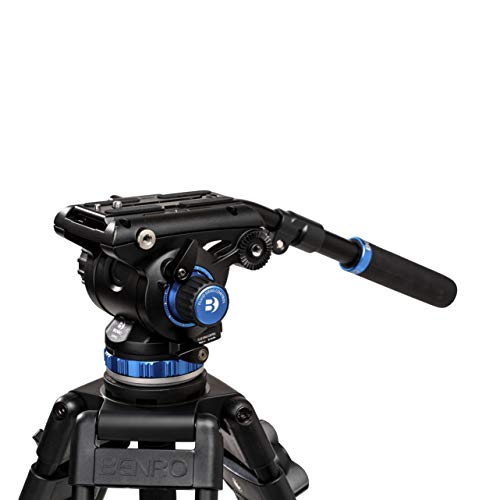
Benro
Benro S6 PRO Fluid Video Head
13.2 lb capacity and six counterbalance steps, enough for a caged mirrorless body with a monitor and a fast zoom.
- Capacity
- 13.2 lb
- Steps
- 6
The value head for a mixed kit.
Check price
Benro
Benro S8 PRO Fluid Video Head
17.6 lb capacity with eight counterbalance steps and a 3/8-16 accessory thread, which covers a cinema body with a matte box and rods.
- Capacity
- 17.6 lb
- Steps
- 8
Buy this if your rig passes 13 lb.
Check priceMatching the head to the rig, with numbers
| Rig | Typical loaded weight | Head class |
|---|---|---|
| Bare mirrorless body and a small prime | 2 to 3 lb | 8.8 lb, two steps is fine |
| Caged body, zoom, monitor, microphone | 4 to 6 lb | 8.8 to 13.2 lb, more steps is better |
| The same plus matte box, follow focus, V-mount | 8 to 11 lb | 13.2 lb minimum, six steps |
| Small cinema body with a zoom and wireless focus | 12 to 18 lb | 17.6 lb, eight steps |
| Fully built cine camera with a cine zoom | 20 lb and up | 100mm bowl class, professional head |
Capacity is not a safety limit in the structural sense, it is the point where the counterbalance can no longer hold the tilt. A head at 90 percent of capacity works. A head at 130 percent of capacity has a tilt axis that must be locked to stay put, which means you have bought a very expensive locked ball head. Get the number from the rig weight calculator rather than estimating.
Height above the head matters as much as mass
Counterbalance opposes a torque, and torque is mass multiplied by distance from the pivot. Two rigs of identical weight need different counterbalance settings if one sits low on a plate and the other sits tall on a riser with a monitor on an arm above it. This is why a head that felt perfect yesterday feels wrong today after you moved the monitor.
The practical consequence is to mount low. Keep the camera close to the head, put the monitor on a short arm rather than a long one, and avoid stacking risers. A low rig needs less counterbalance, settles faster after a move and is less affected by wind.
It also means the balance point front to back matters. Slide the plate until the rig sits neutral with the tilt unlocked and the counterbalance off, then set the counterbalance. Setting counterbalance on an unbalanced rig is how people end up with a head that seems to have two wrong settings and nothing in between.
Kits and professional heads
$600 to $3,331. A hybrid photo and video kit, and two heads a working crew buys once and keeps for decades.

Manfrotto
Manfrotto 500X Fluid Video Head with Hybrid Tripod
A photo and video hybrid kit that levels quickly and pans smoothly, aimed at operators who shoot both on the same body.
- Type
- Head plus legs
A compromise on purpose, and a good one.
Check price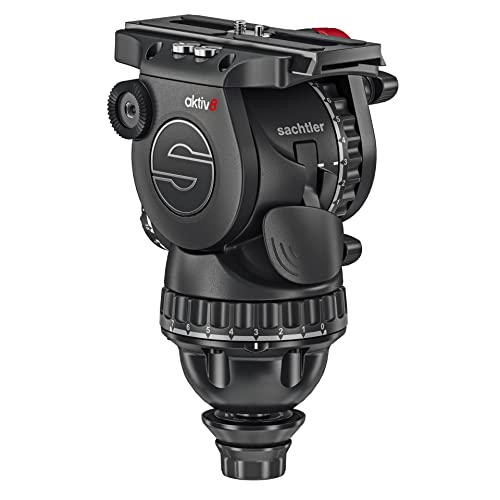
Sachtler
Sachtler aktiv8 Fluid Head
Sideload balancing with SpeedLevel, which is the head a working crew buys because it rebalances in seconds between setups and lasts decades.
- Class
- Professional
- Feature
- SpeedLevel
Nobody needs this for a solo YouTube rig.
Check price
Miller
Miller CX14 Fluid Head
A 100mm-class head for a fully built cine camera with a zoom, matte box and wireless focus hanging off it.
- Class
- Heavy cine
Only for genuinely heavy builds.
Check priceWhat professional heads actually buy you
The Sachtler aktiv8 Fluid Head costs around $1,995 and does the same job as a $265 head, which sounds absurd until you look at what changes. Sideload balancing means the camera slides onto the head from the side and is balanced in seconds rather than by sliding a plate back and forth. SpeedLevel levels the head with one hand while the other hand steadies the camera. On a shoot with sixty setups a day, that is time and fatigue that turn into money.
The second thing is consistency over temperature. A cheap fluid head uses a grease whose viscosity changes noticeably between a cold morning and a hot afternoon, so the drag you set at dawn is not the drag you have at noon. Professional heads use sealed fluid cartridges designed to hold a constant characteristic across a wide temperature range.
The third is longevity. These heads are rebuildable and last decades, which changes the cost calculation for anybody using one daily. For anybody using one a few times a month, it does not, and a $265 head is the right answer.
Setting up a head properly, in order
- Level the legs or the bowl first. Everything else assumes level, and a head on an unlevel base produces a pan that drifts up or down across the move.
- Mount the camera and slide the plate until the rig sits neutral with the tilt unlocked and the counterbalance at zero. This is balance, not counterbalance.
- Set the counterbalance step until the camera holds still at any tilt angle and returns gently rather than snapping.
- Set the tilt drag for the shot: heavy for slow reveals, lighter for following a person.
- Set the pan drag independently, usually a little lighter than the tilt.
- Position the pan bar so your hand rests on it naturally at the height you will be standing. Most people set it too short.
The step people skip is the second one. Counterbalance cannot fix a rig that is not balanced front to back, and trying to make it fix that is why a head can seem to have one setting that is too weak and the next one that is too strong.
How we chose
These picks come from published capacity and counterbalance specifications, stated base and bowl standards, documented drag mechanisms, and verified owner reviews describing behaviour across temperatures and over years of use. We did not have every one of these heads in our hands and will not claim otherwise.
The criteria in order: does the counterbalance range actually cover realistic loaded rigs, how many steps it offers, whether drag is fluid rather than friction, how quickly it levels and balances, and how it mounts to legs you may already own.
Next, from here
- Best video tripods
The legs the head has to sit on.
- Tripod and fluid head guide
Levelling, balancing and drag, in order.
- Rig weight calculator
The loaded number a head capacity must cover.
- Best camera sliders
A slider carriage needs a head of its own.
- Narrative pro build
Where a professional head genuinely belongs.
- Best shoulder rigs
What to use when a tripod is the wrong answer.
Common questions
- What is the difference between drag and counterbalance?
- Drag is fluid resistance that slows a movement so pans start and stop without a jerk. Counterbalance is a spring that opposes gravity so a tilted camera holds its position instead of falling forward. They are separate mechanisms and a head can have good drag and no counterbalance at all, in which case the tilt must be locked and cannot be used during a shot.
- How many counterbalance steps do I need?
- Two steps works if your rig weight never changes. Six or more matters as soon as you switch between a bare body and a fully rigged one, because each step is a discrete spring setting and a rig between two steps will either creep forward or spring back. More steps means a finer match, and a matched head feels weightless while an unmatched one fights you in one direction.
- Can I put a fluid head on my existing photo tripod?
- Usually yes, and it is often the cheapest useful upgrade in a whole kit. A flat base fluid head bolts on with a 3/8-16 screw once the ball head is removed. Check that the legs are rated for the combined weight and that they do not flex noticeably, because a good head on flexing legs shows the flex in every pan.
- Why does my camera nod forward when I release the tilt?
- Either the counterbalance is set too low for the rig, or the rig is not balanced front to back on the plate. Fix the balance first: slide the plate with counterbalance at zero until the camera sits neutral. Then raise the counterbalance step until it holds at any angle. Setting counterbalance on an unbalanced rig produces a head that seems to have one setting too weak and the next too strong.
- Does the height of my rig affect the head setting?
- Yes, considerably. Counterbalance opposes a torque, which is mass multiplied by its distance from the pivot, so a tall rig on risers with a monitor high on an arm needs more counterbalance than the same weight mounted low. This is why a head that felt right yesterday feels wrong after you moved the monitor. Mounting low also settles faster after a move and resists wind better.
- Is an expensive professional head worth it?
- For daily use, yes. Sideload balancing and one-handed levelling save real time across sixty setups a day, sealed fluid cartridges hold consistent drag from a cold morning to a hot afternoon, and the heads are rebuildable and last decades. For a few shoots a month, none of that pays back, and a well chosen head at around $265 does the same job on screen.
Totalling your own rig weight against your gimbal payload? The Camera Rig Build Planner is the paid version of these pages: 8 printable worksheets you fill in with your own numbers, plus the full PDF, $29.