Best Camera Cages for Video Rigs in 2026
Short answer
For most people the best camera cage is the one cut for your exact body: the Tilta Full Camera Cage for FX3 and FX30 at $83 is the pattern to copy, because a body-specific cage with a NATO rail and an HDMI cable clamp solves mounting and cable strain at once. If you expect to change cameras soon, buy the NEEWER Universal Camera Cage with top handle at $78 instead.
A cage is the first thing most people buy and the thing most people buy twice. The winner for a body-specific build is the Tilta Full Camera Cage for FX3 and FX30, currently around $83, because it combines a NATO top plate with an HDMI cable clamp, and the cable clamp is the part that saves a shoot. If your camera choice is not settled yet, the NEEWER Universal Camera Cage with CA007 Top Handle is the honest answer instead: a universal frame plus an ARRI-pinned top handle for less money than the cage alone on some bodies.
Below, the picks are split three ways, because a cage buys different things at different stages. At the starter tier you are buying mounting points. In the middle you are buying a body-specific fit and a cable clamp. At the top you are buying a system: quick release, rod support and rosettes that match the rest of your kit.
Who should skip a cage entirely
If your camera never carries more than one accessory, a cage is weight and cost with no return. A body on a tripod with a shotgun microphone in the hot shoe does not need one. Neither does a body that lives on a gimbal, where every gram you add reduces the payload headroom you paid for, and where the cage often blocks the balance adjustment. Run the numbers on our gimbal payload calculator before you cage a camera that spends most of its life stabilised.
The moment a cage starts to pay is the moment you need two things attached at once. A monitor and a microphone. A microphone and a light. A monitor and an external battery. At that point the alternative is a stack of cold shoe adapters, and stacked adapters rotate, sag and eventually drop something.
Starter tier: buy mounting points, not a system
Starter picks
Under $80. The goal at this tier is a handle you can carry the rig by and enough threads to stop stacking adapters.

NEEWER
NEEWER Universal Camera Cage with CA007 Top Handle
A universal cage plus an ARRI-pinned top handle in one box, so a first rig gets mounting points and a proper carry handle without buying a camera-specific frame.
- Fit
- Universal
- Mounts
- 1/4-20, 3/8-16 ARRI, cold shoe
Best if you expect to change bodies within a year.
Check price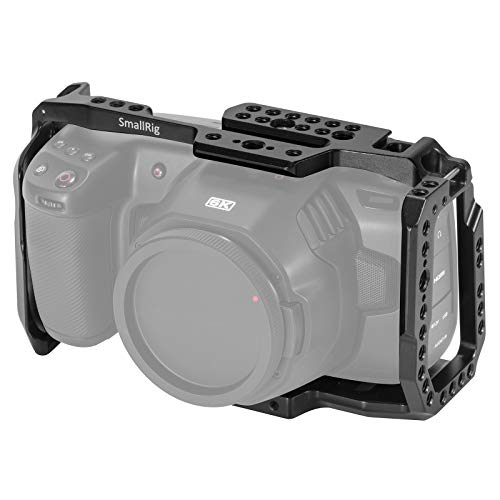
SMALLRIG
SmallRig Cage for BMPCC 4K and 6K
The cage almost every Pocket 4K and 6K ends up wearing, with a NATO rail and cold shoe, because the bare body has almost no mounting points.
- Fit
- BMPCC 4K / 6K

SMALLRIG
SmallRig Cage for Sony FX3 and FX30
A half cage with an HDMI cable clamp, which is the failure point on these bodies because the port is small and the monitor cable is not.
- Fit
- FX3 / FX30
The NEEWER Universal Camera Cage with CA007 Top Handle is the sensible first purchase for anyone whose camera might change. It ships with a top handle carrying 3/8 inch ARRI pins, four 1/4-20 threads and three cold shoes, which covers a monitor, a microphone and a small light at once. The handle alone is worth most of the price, and it will move to your next cage.
For Blackmagic Pocket bodies the calculation is different, because those cameras ship with almost no mounting points at all. The SmallRig Cage for BMPCC 4K and 6K is the cage those bodies effectively require rather than merely benefit from, and it adds a NATO rail and a cold shoe to a chassis that otherwise offers one thread underneath.
Sony FX3 and FX30 owners are in an unusual position: the body already has a good handle in the box, so what a cage adds is the HDMI clamp and the side mounting points. The SmallRig Cage for Sony FX3 and FX30 is a half cage that does exactly that and nothing else.
What starter tier gets wrong
The common mistake is buying a cage with a lot of threads and no NATO rail. Threads are cheap to machine and look generous on a spec sheet, but a 1/4-20 screw is a friction joint. It works loose, and it rotates under a lever load, which is exactly what a monitor on an arm is. A NATO rail and an ARRI locating point are the two features worth paying for at any tier.
Working tier: body-specific fit and a cable clamp
Working picks
$50 to $105. Cut for one chassis, with port cutouts that line up and a clamp that protects the HDMI or USB-C port.

Tilta
Tilta Full Camera Cage for FX3 and FX30
A body-specific frame with a NATO rail on top, a cold shoe and an HDMI cable clamp, which is the part that saves a shoot when a monitor cable gets tugged.
- Fit
- Sony FX3 / FX30
- Top
- NATO rail
The pick if you shoot an FX3, FX3A or FX30.
Check price
SMALLRIG
SmallRig A7 IV / A7R V Cage Advanced Kit
Cage, handle and cable clamp sized to the Alpha bodies, with an Arca base so it drops straight onto a fluid head or a gimbal plate.
- Fit
- Sony A7 IV / R V / V
- Base
- Arca compatible
For A7 IV, A7R V and A7 V shooters.
Check price
SMALLRIG
SmallRig Cage Kit for Lumix S5 II, S5 IIX and G9 II
One cage covers three Panasonic bodies, with a NATO handle and cable clamp included.
- Fit
- S5 II / S5 IIX / G9 II
The Tilta Full Camera Cage for FX3 and FX30 earns the top spot here. It has the NATO top plate, the cold shoe, both 1/4-20 and 3/8-16 ARRI points, and the HDMI clamp. On these bodies the HDMI port is a micro connector soldered to a board, and the monitor cable is stiff. Without a clamp, one snag transfers all of that force into the port. With a clamp, the cable pulls against the cage instead.
Alpha shooters want the SmallRig A7 IV / A7R V Cage Advanced Kit, which covers the A7 IV, A7R V and A7 V with an Arca base, so the rig drops straight onto a fluid head or a gimbal plate without a separate plate. Panasonic shooters get an unusually good deal from the SmallRig Cage Kit for Lumix S5 II, S5 IIX and G9 II, since one cage kit covers the S5 II, S5 IIX and G9 II, and it includes both the NATO handle and the cable clamp.
| Feature | What it does | Worth paying for? |
|---|---|---|
| NATO rail | Tool-free handle and accessory clamping, cannot rotate | Yes, on every build |
| ARRI 3/8-16 locating points | Anti-rotation for anything heavy | Yes, if you mount a monitor or grip |
| HDMI or USB-C cable clamp | Transfers cable strain to the cage | Yes, if you ever use a monitor |
| Arca-compatible base | Drops onto a tripod head or gimbal plate directly | Yes, if you switch supports often |
| Quick release plate system | Cage comes off the plate in one motion | Only if you reconfigure daily |
| Integrated rod clamp | 15mm rods without a separate baseplate | Only on a narrative build |
Expert tier: a system, not a bracket
Expert picks
$125 to $160. Kits that include the handle and baseplate, or quick-release systems for operators who reconfigure between setups all day.
Tilta
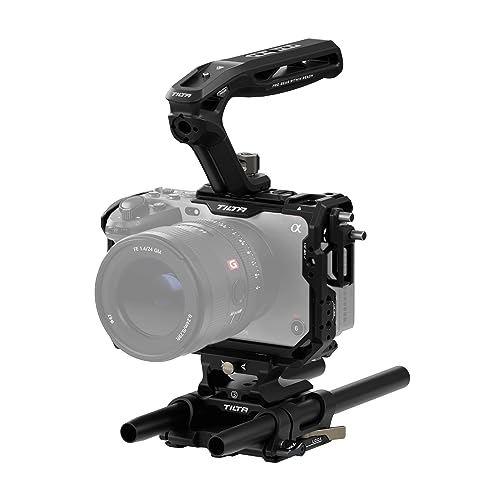
Tilta Camera Cage Basic Kit for FX3 and FX30
The cage bundled with a top handle and baseplate, which is most of the rigging a small documentary build needs in one purchase.
- Includes
- Cage, handle, baseplate
Cheaper than buying the three pieces separately.
Check price
Tilta
Tilta Camera Cage Basic Kit for Sony FX6
ARRI rosettes and 15mm rod support on a cage built for a camera that already has an XLR handle, which is what a narrative build actually hangs accessories from.
- Fit
- Sony FX6
- Rods
- 15mm LWS
FX6 owners building a full rig.
Check price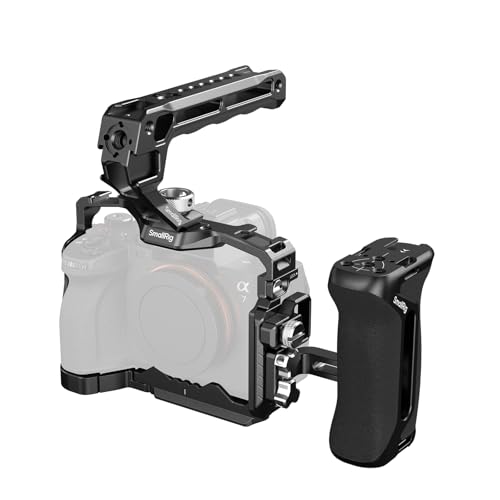
SMALLRIG
SmallRig HawkLock Quick Release Cage Advanced Kit
A quick-release cage designed to come off the plate in one motion, which matters when the same body moves between a gimbal, a tripod and a shoulder rig in a day.
- Release
- HawkLock quick release
For operators who reconfigure constantly.
Check priceThe Tilta Camera Cage Basic Kit for FX3 and FX30 bundles the cage, the top handle and the baseplate, which is most of the rigging a small documentary build needs, and it costs less than buying those three pieces separately. If you already know your build is heading toward rods and a matte box, buying the kit rather than the bare cage saves both money and a second delivery.
Cinema bodies are a different problem. The Tilta Camera Cage Basic Kit for Sony FX6 exists not to add mounting points to a body that lacks them, since the FX6 has plenty, but to add ARRI rosettes and 15mm rod support in the right places. Rosettes are what a handgrip needs, and rods are what a matte box, a follow focus and a lens support all hang from.
The SmallRig HawkLock Quick Release Cage Advanced Kit is the pick for one specific working pattern: an operator who moves the same body between a gimbal, a tripod and a shoulder rig several times a day. The quick release comes off the plate in one motion, which turns a two-minute reconfiguration into a five-second one. If you do not reconfigure constantly, you are paying for a mechanism you will not use.
Who should not buy the expert tier
If your rig gets built once and stays built, skip the quick-release systems. They add height, mass and a mechanical interface that can go out of tolerance. A plain cage bolted directly to a plate is stiffer and lighter, and stiffness is what keeps a monitor from wobbling in the frame during a handheld move.
The rigging that goes with the cage
A cage on its own does not do much. The three parts that turn it into a rig are a handle, a monitor mount and, on a narrative build, rods.
What to buy with it
Under $30 each, and each one solves a specific failure: carrying the rig, holding the monitor, and supporting anything in front of the lens.

SMALLRIG
SmallRig Lightweight NATO Top Handle
A NATO handle comes off in one motion without tools, which is the difference between a rig that packs down and one that fights you.
- Mount
- NATO rail
Needs a NATO rail on the cage.
Check price
SMALLRIG
SmallRig Monitor Mount with NATO Clamp
Clamps a 5 or 7 inch monitor to a NATO rail and swivels, which keeps the HDMI strain off the camera port.
- Fits
- 5 to 7 in monitors
Better than a cold shoe for anything heavy.
Check price
SMALLRIG
SmallRig Baseplate Kit with 15mm Rod Clamp
The baseplate and rods that a matte box, follow focus and lens support all hang from, so it is the part to buy before any of those.
- Rods
- 15 mm LWS
Buy this before a matte box.
Check priceThe SmallRig Monitor Mount with NATO Clamp deserves particular attention. Mounting a monitor to a cold shoe puts a lever arm on a piece of sprung metal designed to hold a flash. A NATO clamp spreads the load along the rail and cannot rotate. If you take one thing from this page beyond the cage itself, make it that.
How we chose
These picks come from published manufacturer specifications, stated materials and load ratings, mounting standards documentation, and verified owner reviews describing long-term use. We did not have all of these cages in our hands, and we are not going to claim otherwise. What we can do is read the specifications carefully and point out which features actually change how a rig behaves.
The criteria, in order of weight: does it have a NATO rail, does it have ARRI locating points where load will be carried, does it clamp the video cable, does it leave the battery door and card door usable, and does it clear any cooling intake. Price mattered less than any of those, because the difference between a good cage and a poor one is rarely more than forty dollars, and a dropped monitor costs considerably more.
Fit notes by camera
Cage fit is the most common return in this category. Three specific traps:
- Lens tripod collars. Many universal cages will not accept a lens with a tripod collar ring fitted, because the collar fouls the base plate. Remove the collar or check clearance before ordering.
- Battery and card doors. A cage that blocks the battery door turns every battery change into a disassembly. Body-specific cages get this right, generic ones frequently do not.
- Cooling intakes. Bodies with active cooling, including the Canon R5 C and the Fujifilm X-H2S with its fan accessory, need the intake and its accessory mount left clear. See our Canon EOS R5 C rig setup page for the specifics on that body.
What to buy first if the budget is tight
In order: a cage cut for your body, a NATO top handle, then a monitor mount. That sequence costs under $130 for most cameras and covers the three things that stop a rig being frustrating. Rods, a matte box and a follow focus can wait until you know you need them, and on a run and gun build you may never need them at all. Our run and gun starter build shows the full list in context, with the totals stated.
Next, from here
- Both complete build ladders
Run and gun and narrative, three tiers each, every line priced.
- Mounting standards explained
1/4-20, 3/8-16, ARRI pins, NATO and rosettes.
- Cage versus top handle only
When a handle alone is genuinely enough.
- Best on-camera monitors
The accessory the cage is usually bought for.
- Rig weight calculator
What the cage adds, and what that costs you on a gimbal.
- Thread and mount reference chart
Every thread, pin spacing and rail dimension in one table.
Common questions
- Do I actually need a camera cage?
- You need a cage when you need to attach two or more accessories at once. A bare mirrorless body has one or two 1/4-20 threads and a single cold shoe, which is enough for a microphone or a monitor but not both. A cage converts the body into a grid of 1/4-20 and 3/8-16 ARRI points so a monitor, a microphone, a top handle and a power cable can all mount without stacking adapters on the hot shoe.
- What is the difference between a half cage and a full cage?
- A half cage covers the base and one side, adding an Arca base plate and a few threads while leaving the body mostly exposed. A full cage wraps the whole camera and adds mounting points on every face plus, usually, a cable clamp. Half cages are lighter and faster to fit, full cages give more mounting positions and protect the ports. A run and gun build is usually happier with a half cage, and a narrative build with a full one.
- What is a NATO rail and why does it matter?
- A NATO rail is a standard dovetail strip, 44mm wide with a fixed profile, that a matching clamp slides onto and locks with a lever. It matters because it lets a top handle or a monitor mount come off in one motion without tools, and it cannot rotate under load the way a single 1/4-20 screw can. If a cage has a NATO rail on top, the handle you buy will fit any other NATO cage you own later.
- Is an ARRI 3/8-16 locating pin worth paying for?
- Yes, on anything that carries weight. An ARRI locating point is a 3/8-16 thread flanked by two 4.5mm holes. The pins stop the accessory from rotating around the screw, which is the failure mode that drops a monitor mid-take. A plain 1/4-20 thread relies entirely on friction, so it works loose. Anything holding a heavy monitor, a rosette handle or a battery plate should use ARRI points if the cage offers them.
- Will a cage stop my camera from overheating?
- No, and a badly designed one makes it worse by covering a vent. Cages are aluminium and do conduct some heat away from the body shell, but the limiting factor on a mirrorless camera is internal airflow and sensor readout, not the case surface. If your body has a fan intake, like the Canon R5 C or the Fujifilm X-H2S with its cooling accessory, check that the cage you buy leaves that intake and its accessory mount clear.
- Can I use a body-specific cage on a different camera?
- Usually not. Body-specific cages are cut for one chassis, and the screw positions, port cutouts and battery door clearance will not line up on another body. Universal cages exist and work, at the cost of covering some controls and adding bulk. If you expect to change bodies within a year, buy a universal cage or a quick-release system now and a body-specific cage once your camera choice has settled.
Totalling your own rig weight against your gimbal payload? The Camera Rig Build Planner is the paid version of these pages: 8 printable worksheets you fill in with your own numbers, plus the full PDF, $29.