Gimbal Payload Calculator: Will Your Rig Balance?
Short answer
Add every gram that sits on the gimbal plate, including the lens, cage, monitor, plate and card, then compare that total to the manufacturer's rated payload. Stay at or under roughly 75 percent of the rating for comfortable work: a 3 kg rated gimbal such as the DJI RS 4 is genuinely happy at about 2.25 kg.
A gimbal fails in one of two ways: the motors cannot hold the weight, or your arms cannot hold the gimbal. This calculator answers the first question, and the answer to the second is almost always a support vest rather than a different stabiliser. For most mirrorless builds the DJI RS 4 at around $469 and its 3 kg rating is the right class, and the maths below tells you whether your rig fits inside it.
Calculator
Runs in your browser
Enter what actually sits on the plate. Weights are in grams, and the readout converts to pounds and to a percentage of your gimbal's rating.
Total on the plate
0 g
0.00 lb
Of rated payload
0%
0 g of headroom
Verdict
-
Green to 75 percent, amber to 90, red above
The formula, stated plainly
Total payload is the sum of everything mounted forward of the gimbal's quick release plate. That is the camera body, the lens with any filter or adapter, the cage or half cage, the plate itself, the monitor and its mount, the battery, the memory card, and every cable and bracket. It does not include the gimbal, its grip, its own battery or a support vest, because those are carried by you rather than by the motors.
Percentage of rating is total divided by the rated payload. The working thresholds:
| Percentage of rating | What it feels like | Do this |
|---|---|---|
| Under 60% | Effortless. Fast balancing, cool motors, long battery life | You could add a monitor or a bigger lens |
| 60 to 75% | The intended operating zone. Stable and responsive | Nothing. This is where you want to be |
| 75 to 90% | Balancing gets fussy, motors warm, runtime drops | Works, but rebalance carefully and expect shorter days |
| Over 90% | Visible micro-corrections, drift, overheating warnings | Change the lens or move up a payload class |
Typical weights, so you can estimate before you buy
These are representative published figures for common categories, useful for planning a build you do not own yet. Always check the specification for your exact model.
| Component | Typical weight | Note |
|---|---|---|
| Compact cine body, Super 35 | 550 to 700 g | Body with battery and card |
| Full frame mirrorless or compact cine | 650 to 900 g | Add 100 g for a cage plate |
| Small crop zoom, f/2.8 | 280 to 400 g | The gimbal lens on most builds |
| Fast full frame standard zoom | 700 to 900 g | Often the single heaviest item |
| Manual cine prime | 500 to 800 g | Heavier than a stills prime of the same focal length |
| Half cage | 150 to 300 g | The gimbal-friendly choice |
| Full cage with handle | 400 to 700 g | Also raises the centre of mass |
| 5 inch monitor with mount and cable | 250 to 400 g | The mount is a third of it |
| 99 Wh V-mount battery | 550 to 650 g | Rarely worth putting on a gimbal |
| Matte box with two filters | 500 to 900 g | Worst possible place for mass on a gimbal |
Weight is not the only problem: where the mass sits matters more
Two rigs of identical total weight can behave completely differently. A gimbal balances when the centre of mass of the payload sits on each axis of rotation. If the mass is concentrated far forward, on a long lens or a matte box, you may run out of slide range on the tilt axis before you find balance, even though the total is well inside the rating.
That is why a heavy body with a small lens is easier to balance than a light body with a long one. It is also why the fix for a stubborn tilt axis is often a SmallRig Removable Gimbal Counterweight, 200g at the back rather than a bigger gimbal. The centre of gravity guide covers the geometry, and the balancing guide covers the axis by axis procedure.
Choosing a payload class
The three payload classes that matter
Ratings are for a balanced load. The class you want is the one where your real total lands between 60 and 75 percent.
DJI
DJI RS 3 Mini
The lightest way into a stabilised camera, rated for 2 kg, which is a mirrorless body and one small prime and nothing else.
- Rated payload
- 2 kg / 4.4 lb
- Axis
- 3-axis
Do not plan to hang a monitor on this.
Check price
DJI
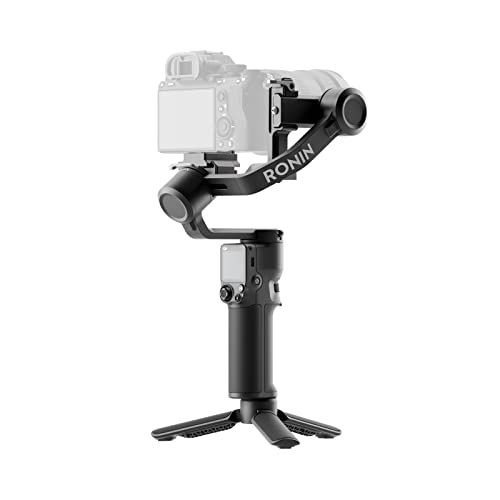
DJI RS 4
The 3 kg workhorse, with second-generation axis locks and a teflon-coated tilt arm so rebalancing after a lens change takes seconds rather than minutes.
- Rated payload
- 3 kg / 6.6 lb
- Focus motor
- Optional
The pick for most mirrorless documentary rigs.
Check price
DJI
DJI RS 4 Pro
Rated for 4.5 kg with a carbon fibre axis arm and native support for LiDAR focus, which is the version that carries a cinema body with a matte box and a monitor.
- Rated payload
- 4.5 kg / 10 lb
- Focus
- LiDAR compatible
Overkill for a bare mirrorless body.
Check priceThe DJI RS 3 Mini and its 2 kg class covers a compact body with a small prime and nothing else. Add a monitor and you are already at the ceiling. The DJI RS 4 at 3 kg is the class most mirrorless builds belong in. The DJI RS 4 Pro at 4.5 kg exists for cinema bodies, and it is genuinely too much gimbal for a bare mirrorless camera.
The limit nobody puts on the spec sheet
What actually extends a gimbal day
A vest to move the load to your hips, a counterweight to fix a stubborn tilt axis, and a grip for low mode and standing rests.

Tilta
Tilta Lightweight Gimbal Support Vest
Moves a gimbal's weight to your hips, which is the cheapest fix for the real limit on gimbal work, which is your arms and not the motors.
- For
- DJI RS series
Buy this before a bigger gimbal.
Check price
SMALLRIG
SmallRig Removable Gimbal Counterweight, 200g
Balances a heavier lens on a gimbal without buying a bigger gimbal, which is the cheapest fix for a tilt axis that will not settle.
- Weight
- 200 g

DJI
DJI RS Extended Grip and Tripod
The grip that turns a gimbal into a low-mode handle and a standing support, and it is the first accessory most gimbal owners actually need.
- For
- DJI RS series
Buy it with the gimbal.
Check priceThe real constraint on gimbal work is operator fatigue. A 4.5 kg payload on a 1.4 kg gimbal is roughly six kilos held out in front of your body, and the leverage means it feels far heavier than six kilos on your back. The Tilta Lightweight Gimbal Support Vest at around $119 does more for a long gimbal day than any upgrade to the stabiliser itself, which is the single most counterintuitive piece of advice on this page.
Worked example: a full frame documentary build
A full frame cine body at 716 g, a fast standard zoom at 695 g, a half cage and plate at 320 g, a five inch monitor with a NATO mount and cable at 330 g, plus battery and card at 180 g. That totals 2,241 g, which is 75 percent of a 3 kg rating. Workable, and right at the edge of comfortable.
Swap the standard zoom for a small crop zoom at 290 g and the total drops to 1,836 g, which is 61 percent. That single lens change moves the rig from the top of its class into the middle of it, and it costs nothing if you already own both lenses. This is exactly why both the working run and gun build and the pro tier keep a small zoom in the bag alongside the good one.
What to do if you are over
- Change the lens. Free, immediate, and usually enough.
- Take the monitor off. Most gimbal shots are framed wide and reviewed after. The camera's own screen is often adequate for the take itself.
- Drop the cage to a half cage or a bare plate. Saves 200 to 400 g and lowers the centre of mass, which helps twice.
- Remove the matte box. It has no business on a gimbal, and a screw-on variable ND does the exposure job for a fraction of the mass.
- Then, and only then, buy a bigger gimbal. Along with the vest, since the heavier stabiliser makes the fatigue problem worse.
Next, from here
- Rig weight calculator
Total build weight, including what you carry.
- Best gimbals
Every payload class, three tiers.
- How to balance a gimbal
The axis by axis procedure.
- Gimbal payload reference chart
Ratings and practical limits in one table.
- Gimbal versus shoulder rig
When stabilisation is the wrong answer.
- Run and gun working build
A rig sized to a 3 kg gimbal on purpose.
Common questions
- How much under a gimbal payload rating should I stay?
- Aim to sit at or under about 75 percent of the rated payload for comfortable operation, and treat 90 percent as the absolute ceiling. Ratings are quoted for a perfectly balanced load in still air. Real shooting adds walking motion, wind and an off-centre lens, and a motor working near its limit runs hot, drifts and produces visible micro-corrections in the footage.
- Does the gimbal payload include the gimbal itself?
- No. The rating describes what the gimbal can carry, not what you can carry. A 4.5 kg rated stabiliser weighs roughly 1.4 kg on its own, so a fully loaded rig is nearly 6 kg in your hands. That total is what fatigues you, which is why a support vest is usually a better purchase than a larger gimbal.
- Why does my gimbal drift even though I am under the payload?
- Almost always because the balance is off rather than the load being too heavy. A gimbal only holds position if the centre of mass sits on each axis of rotation. An unbalanced load makes the motors hold a constant torque, which they can do briefly and not indefinitely. Rebalance after every lens change, and check the tilt axis by leaving the camera at 45 degrees.
- Do I need to rebalance after changing a filter?
- For a screw-on variable ND, usually a small tilt adjustment is enough. For a matte box, yes, completely, because the mass is significant and it sits far forward on a long lever. Anything that changes the weight in front of the lens mount changes the tilt balance most, then the roll balance, and the pan axis least.
- Can I use a cage on a gimbal?
- Yes, but count the cost. A cage typically adds 200 to 650 grams and raises the camera on the plate, which moves the centre of mass and can leave you unable to slide far enough back to balance. If the camera lives on a gimbal, a half cage or a bare body with a plate is usually the better choice.
- What weighs more than people expect on a rig?
- Batteries and glass. A 99 Wh V-mount cell is roughly 600 grams, a fast full frame standard zoom is around 700 to 900 grams, and a matte box with two filters can pass 700 grams. Monitors are lighter than they feel at 200 to 400 grams. Cables and small brackets add up to more than anyone estimates.
Totalling your own rig weight against your gimbal payload? The Camera Rig Build Planner is the paid version of these pages: 8 printable worksheets you fill in with your own numbers, plus the full PDF, $29.