Gimbal Payload Chart: Rated and Safe Working Loads by Model
Short answer
Treat a rated payload as a ceiling, not a target, and plan for 70 to 80 percent of it. A 3 kg rated gimbal comfortably carries a 2.1 to 2.4 kg rig, which is a caged full frame body with a fast standard zoom. A caged body with a monitor and a battery plate is usually already past that window.
A rated payload is the mass the motors can hold against gravity when the load is perfectly balanced, and it is not the mass at which a gimbal works well. The chart below pairs rated figures with a 70 to 80 percent working window, and pairs those against real rig weights so a DJI RS 4 can be matched to an actual build rather than to a hopeful estimate.
Rated payload against safe working load
| Gimbal | Rated payload | Safe working load at 75% | Suits |
|---|---|---|---|
| DJI RS 3 Mini | 2.0 kg / 4.4 lb | 1.5 kg / 3.3 lb | Bare mirrorless and one small prime |
| DJI RS 4 Mini | 2.0 kg / 4.4 lb | 1.5 kg / 3.3 lb | Compact bodies, travel and events |
| Zhiyun Weebill 3S | 3.0 kg / 6.6 lb | 2.25 kg / 5.0 lb | Caged crop body with a fast zoom |
| DJI RS 4 | 3.0 kg / 6.6 lb | 2.25 kg / 5.0 lb | Caged full frame with a fast zoom |
| Zhiyun Crane 4 | Above 3 kg class | About 2.6 kg / 5.7 lb | Heavier mirrorless and small cine bodies |
| DJI RS 4 Pro | 4.5 kg / 10 lb | 3.4 kg / 7.5 lb | Cinema body with a monitor and matte box |
| DJI RS 4 Pro Combo | 4.5 kg / 10 lb | 3.4 kg / 7.5 lb | The above, with transmitter and focus motor |
The gap between the two columns is where most disappointment lives. A 3 kg gimbal will hold 3 kg and it will do so with no reserve, running hot, draining its battery and producing a soft lagging correction on any fast move. At 2.25 kg the same gimbal feels effortless.
Typical rig weights
| Build | Typical weight | Fits |
|---|---|---|
| Bare crop body and a small prime | 0.9 to 1.2 kg | Any gimbal, comfortably |
| Bare full frame body and a compact prime | 1.2 to 1.5 kg | 2 kg class, at the top of its window |
| Caged crop body and an f/2.8 crop zoom | 1.5 to 1.8 kg | 3 kg class comfortably |
| Caged full frame body and an f/2.8 zoom | 2.0 to 2.4 kg | 3 kg class, in its window |
| The above plus a small monitor | 2.3 to 2.8 kg | 3 kg class at its limit, or 4.5 kg class |
| The above plus a V-mount plate | 3.0 to 3.6 kg | 4.5 kg class |
| Small cinema body with a zoom and monitor | 3.5 to 4.5 kg | 4.5 kg class at its limit |
| Cinema body with matte box and wireless focus | 5 kg and up | Beyond handheld gimbals |
Read the two tables together. A caged full frame body with a fast zoom at 2.0 to 2.4 kg sits inside the 3 kg class working window with almost nothing to spare, which is why adding a monitor and a battery plate to that build pushes it into needing the 4.5 kg class. That progression is the single most common way people end up owning two gimbals.
Why the working load is lower than the rating
The rated figure is what the motors can hold statically at perfect balance. Operating a gimbal is not static: a whip pan, a sudden direction change or a step down a kerb all demand torque above what gravity alone requires, and a gimbal at its rating has none left.
The symptoms of running at the limit are specific. Motors get hot, battery life drops sharply, the correction becomes soft and lagging rather than crisp, and on a fast move the horizon can visibly tip as a motor hits its torque limit and gives up.
Seventy to eighty percent leaves enough margin for those demands. It is not a conservative safety factor invented for a chart; it is the load at which a gimbal behaves the way the marketing footage suggests.
The three payload classes
$199 to $869. Two kilograms, three kilograms and four and a half, which is the whole practical range for a handheld stabiliser.
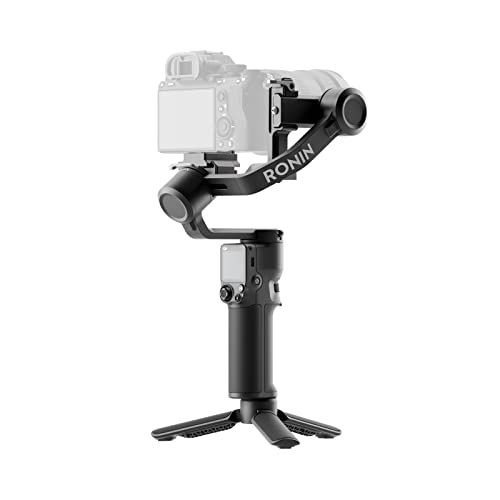
DJI
DJI RS 3 Mini
The lightest way into a stabilised camera, rated for 2 kg, which is a mirrorless body and one small prime and nothing else.
- Rated payload
- 2 kg / 4.4 lb
- Axis
- 3-axis
Do not plan to hang a monitor on this.
Check price
DJI
DJI RS 4
The 3 kg workhorse, with second-generation axis locks and a teflon-coated tilt arm so rebalancing after a lens change takes seconds rather than minutes.
- Rated payload
- 3 kg / 6.6 lb
- Focus motor
- Optional
The pick for most mirrorless documentary rigs.
Check price
DJI
DJI RS 4 Pro
Rated for 4.5 kg with a carbon fibre axis arm and native support for LiDAR focus, which is the version that carries a cinema body with a matte box and a monitor.
- Rated payload
- 4.5 kg / 10 lb
- Focus
- LiDAR compatible
Overkill for a bare mirrorless body.
Check priceBalance is a separate limit from mass
A gimbal must position the centre of mass at the intersection of its three axes, and the quick release plate has finite travel. A long or front-heavy lens can push the centre of mass beyond that range even when the total mass is well inside the rating.
The symptom is a plate slid fully back with the camera still nosing down. The fix is a SmallRig Removable Gimbal Counterweight, 200g at around $12, which adds 200 g at the rear and moves the centre of mass into the adjustable range. It costs twelve dollars and it regularly rescues a rig that appeared to need a larger gimbal.
The distinction matters because the fixes are opposite. If the rig balances with motors off but the motors still struggle, you are over payload and adding weight makes it worse. If it will not balance at all, adding rear weight is exactly right.
What to weigh
- The camera body with its own battery fitted, because the battery is part of the mass.
- The lens you will actually use, with any filter fitted, since a 95mm variable ND is meaningful mass at the very front.
- The cage, plate and any quick release hardware.
- The monitor, its mount and its battery.
- The microphone and its shock mount.
- The memory card, which is negligible, and any cable, which is not.
The rig weight calculator adds all of that up, and the gimbal payload calculator compares the result against specific models with the working load rule applied. Doing both before buying a stabiliser prevents the most expensive mistake in this category, which is a gimbal that cannot carry the rig you already own.
Next, from here
- Gimbal payload calculator
Your rig against a specific model.
- Rig weight calculator
Add up what you actually have.
- Best gimbals
The models behind these figures.
- How to balance a gimbal
The three axis sequence.
- Rig balance and centre of gravity
Why placement matters as much as mass.
- Gimbal versus shoulder rig
Whether a gimbal is the right tool.
Common questions
- What payload gimbal do I need?
- Weigh your loaded rig and target 70 to 80 percent of the gimbal rating. A caged full frame body with a fast standard zoom is typically 2.0 to 2.4 kg, which needs the 3 kg class rather than the 2 kg class. Adding a monitor and a battery plate to that build pushes it toward the 4.5 kg class, which is how people end up owning two gimbals.
- Can I run a gimbal at its rated payload?
- It will hold the load and it will not work well. The rating is what the motors hold statically at perfect balance, and operating demands more than that on every fast move. At the limit, motors run hot, battery life drops sharply, corrections become soft and lagging, and on a whip pan the horizon can visibly tip as a motor reaches its torque limit.
- What does a caged mirrorless rig actually weigh?
- A caged crop body with an f/2.8 crop zoom is typically 1.5 to 1.8 kg. A caged full frame body with an f/2.8 standard zoom is 2.0 to 2.4 kg. Add a small monitor and you reach 2.3 to 2.8 kg, and add a V-mount plate and you are at 3.0 to 3.6 kg, which is past the 3 kg class working window entirely.
- Why will my gimbal not balance under its rated payload?
- Because balance and mass are separate limits. The gimbal must position the centre of mass at the intersection of its axes, and the plate has finite travel, so a long lens can push the centre of mass out of range even under the rating. A 200 g counterweight at the rear moves it back into range and usually fixes it for around twelve dollars.
- Does a monitor push my rig over the payload?
- Frequently, yes. A monitor plus its mount and battery is 300 to 500 g, and on a build already at 2.0 to 2.4 kg that lands right at the top of a 3 kg class working window. It also sits high on the rig, which affects balance as well as mass. Check the numbers before adding one to a stabilised build.
- What should I include when weighing my rig?
- The body with its battery, the lens with any filter fitted, the cage and quick release plate, the monitor with its mount and battery, the microphone with its shock mount, the card and any cables. The filter matters more than people expect: a 95mm variable ND is meaningful mass at the furthest forward point on the whole rig.
Totalling your own rig weight against your gimbal payload? The Camera Rig Build Planner is the paid version of these pages: 8 printable worksheets you fill in with your own numbers, plus the full PDF, $29.