ND Filter and Shutter Angle Calculator
Short answer
Holding the 180 degree shutter rule means a shutter of 1/48 at 24 fps or 1/50 at 25 fps, and in bright sun that usually needs six to eight stops of neutral density at f/2.8 and ISO 800. Each stop of ND halves the light, so ND8 is three stops and ND1000 is ten.
Exposure on video has one fewer control than stills, because shutter speed is locked to the frame rate by the 180 degree rule. That leaves aperture, ISO and neutral density, and outdoors it leaves ND. The PolarPro 82mm McKinnon VND, 2 to 5 Stops at around $250 is the filter most people should own first, and the calculator below shows why a single filter is rarely enough.
Calculator
Runs in your browser
Set your frame rate, aperture and ISO, then pick the lighting condition. The readout gives the shutter speed the 180 degree rule requires and the density needed to hold it.
Shutter speed
1/48
180 degrees at 24 fps
ND needed
0 stops
no filter
Filter to reach for
-
How the maths works
Shutter speed comes from the angle: shutter = angle / (360 x fps). At 180
degrees and 24 fps that is 1/48 second. At 180 degrees and 50 fps it is 1/100.
Exposure value is then compared. The scene has an EV at ISO 100, and your chosen ISO shifts that by log base 2 of the ISO ratio. Your chosen aperture and shutter combine into a camera EV. The difference between the two, rounded up, is the number of stops of neutral density you need. Each stop halves the light.
ND notation, decoded
| Stops | ND number | Optical density | Light passed |
|---|---|---|---|
| 1 | ND2 | 0.3 | 50% |
| 2 | ND4 | 0.6 | 25% |
| 3 | ND8 | 0.9 | 12.5% |
| 4 | ND16 | 1.2 | 6.25% |
| 5 | ND32 | 1.5 | 3.1% |
| 6 | ND64 | 1.8 | 1.6% |
| 7 | ND128 | 2.1 | 0.8% |
| 8 | ND256 | 2.4 | 0.4% |
| 10 | ND1000 | 3.0 | 0.1% |
Three notations for the same thing, which is why filter shopping is confusing. The ND number is the division factor, the density is log base 10 of that factor, and stops are log base 2. The full table lives on the ND stops reference chart.
Why one variable ND is not enough
The variable ND options
A budget filter with a safe range, and the two-filter approach that covers everything from shade to open sun without a cross pattern.
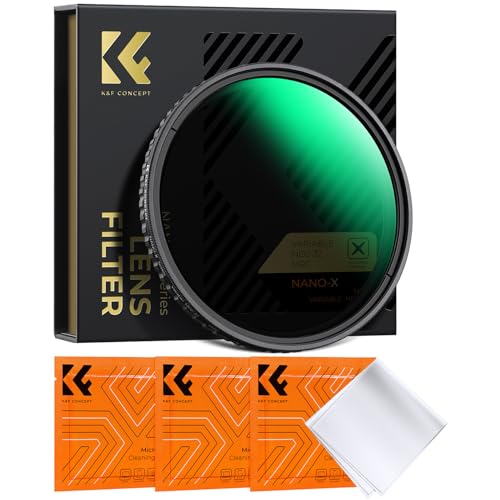
K&F CONCEPT
K&F Concept 82mm Variable ND, 1 to 5 Stops
A 1 to 5 stop range with no cross pattern, which is the safe span for a variable ND: the ugly X appears when you push a wide-range filter to its end.
- Range
- 1 to 5 stops
- Thread
- 82 mm
Use step rings rather than buying one per lens.
Check price
PolarPro
PolarPro 82mm McKinnon VND, 2 to 5 Stops
Hard stops at each end, a deliberately narrow 2 to 5 stop range and cinema-grade glass, which is the combination that keeps colour neutral.
- Range
- 2 to 5 stops
- Stops
- Hard end stops
The pick if you shoot outdoors constantly.
Check price
PolarPro
PolarPro 82mm McKinnon VND, 6 to 9 Stops
The dense half of the pair, for holding a wide aperture at 1/50 in open sun where five stops is not enough.
- Range
- 6 to 9 stops
Owning both beats one very wide filter.
Check priceA variable ND is two polarising layers. Rotating one against the other reduces transmission, and as they approach crossed extinction the effect stops being even across the frame. On a wide lens this shows as a dark X. Filters with a wider advertised range reach that condition, which is why a 1 to 9 stop filter is usually worse than a 2 to 5 stop one despite covering more ground.
The professional answer is two narrow-range filters: the PolarPro 82mm McKinnon VND, 2 to 5 Stops for most conditions and the PolarPro 82mm McKinnon VND, 6 to 9 Stops for open sun at a wide aperture. Both have hard stops so you cannot rotate past the usable range by accident.
Fixed filters, and when to prefer them
The narrative approach
Fixed densities in a matte box tray. Slower to change, cleaner colour, and no cross pattern at any density.

Hoya
Hoya PRO ND-EX 77mm Kit (ND8, ND64, ND1000)
Three fixed densities rather than a variable, which is what you use when colour accuracy matters more than changing exposure without stopping.
- Densities
- 3, 6 and 10 stops
Slower to work with, cleaner results.
Check price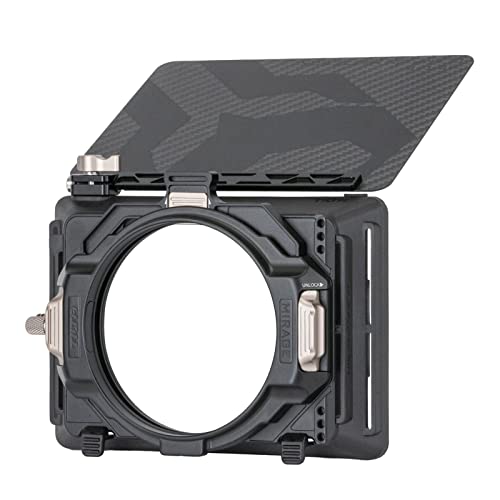
Tilta
Tilta Mirage Matte Box
Takes both 4x5.65 trays and 95mm circular filters with adapter rings down to 67mm, so one box covers a whole mixed set of lenses.
- Filters
- 4x5.65 and 95mm round
- Rings
- 67 to 82 mm
The pick for a small narrative kit.
Check price
K&F CONCEPT
K&F Concept 4x5.65 Filter Tray
A spare tray means the diffusion and the ND both stay mounted, so a change is a swap rather than a rebuild.
- Size
- 4 x 5.65 in
On a planned set you are already stopping between setups, so the speed advantage of a variable filter buys you nothing while its colour compromise still costs you. Fixed glass in a Tilta Mirage Matte Box tray is the standard narrative approach, and a spare K&F Concept 4x5.65 Filter Tray means a change is a swap rather than a rebuild.
Shutter angle as a creative choice
The 180 degree rule is a default, not a law. Narrower angles produce crisper, more urgent motion, which is why action sequences sometimes use 90 or 45 degrees. Wider angles up to 360 produce more blur and pass more light, which occasionally rescues a dark interior at the cost of smeared movement.
What matters is consistency within a sequence. A cut between a 180 degree shot and a 45 degree shot reads as a jolt, which is useful if you meant it and distracting if you did not. The shutter angle guide covers the creative side properly.
Worked example: interview by a window, then outside
Inside at EV 9, shooting 24 fps at 1/48 with ISO 800 and f/2.8, you need no ND at all and may in fact be short of light. Step outside into bright sun at EV 15 and the same settings need roughly six stops. That is a six stop swing while walking through a doorway, which is exactly the situation a variable ND exists for, and exactly the situation a fixed filter handles badly.
The opposite case: a controlled interior where you set one fixed ND and shoot for three hours. There a variable filter is only adding a polariser and a colour shift to a problem that never changes.
Filter size, thread and stacking
Buy the filter for your largest lens thread and use step-up rings for the rest. Filters are expensive and rings cost a few dollars. Stacking multiple screw-in filters is where vignetting starts, especially on wide lenses, and it is another argument for a matte box once your kit grows. See the filter thread reference chart for common sizes and the filtration guide for stacking order.
Next, from here
- Best variable ND filters
Ranges, hard stops and colour neutrality.
- ND stops chart
Stops, ND numbers and density in one table.
- Shutter angle guide
When to break the 180 degree rule.
- Variable versus fixed ND
Which one your kind of shooting needs.
- Exposure tools guide
False colour, zebras and getting it right.
- Depth of field calculator
What holding that aperture costs you in focus margin.
Common questions
- What is the 180 degree shutter rule?
- It means setting the shutter speed to roughly one over double the frame rate: 1/48 at 24 fps, 1/50 at 25 fps, 1/60 at 30 fps. The shutter is open for half of each frame interval, which produces the amount of motion blur audiences read as normal cinematic movement. A faster shutter looks staccato and a slower one smears.
- How many stops of ND do I need in bright sun?
- Bright sun is roughly EV 15 at ISO 100. Holding f/2.8 at 1/50 second on a base ISO of 800, which is common on cine bodies, typically needs six to eight stops of neutral density. That is why a single 2 to 5 stop variable ND is not enough outdoors, and why the dense filter exists as a second purchase.
- Why does my variable ND show a dark cross?
- Because a variable ND is two polarisers rotating against each other, and near the dense end they approach extinction unevenly across the frame. The result is an X pattern, worst on wide lenses. The fix is a filter with a narrower range and hard end stops, or fixed density filters, rather than pushing a wide range filter to its limit.
- Can I use a higher ISO instead of an ND filter?
- Not usefully in bright light, because raising ISO makes the image brighter rather than darker. You would need to lower ISO, and most cine cameras have a fixed base ISO where the sensor performs best. Going below base on a dual gain sensor costs dynamic range, so ND is the correct tool for taking light away.
- Should I use a variable ND or fixed filters?
- Variable for run and gun, fixed for narrative. A variable lets you follow a subject from a window to a hallway without stopping, which is worth some colour compromise. Fixed glass is cleaner and more neutral but requires a stop to change, which on a planned set costs nothing because you are already stopping.
- Does an ND filter change colour?
- Cheaper ones do, and most add a slight warm or magenta cast that gets stronger with density. Variable NDs are worse than fixed ones because they are polarisers. Better filters describe themselves as true colour or IR corrected, the latter mattering because dense NDs can pass infrared that a sensor records as a red cast on dark fabrics.
Totalling your own rig weight against your gimbal payload? The Camera Rig Build Planner is the paid version of these pages: 8 printable worksheets you fill in with your own numbers, plus the full PDF, $29.