Shutter Angle and Frame Rate: The 180 Degree Rule Explained
Short answer
A 180 degree shutter means the shutter is open for half of each frame interval, which at 24 fps is 1/48 second and at 25 fps is 1/50. That produces the motion blur audiences read as cinematic. Because the exposure time is fixed, daylight requires ND filters rather than a faster shutter, which is why ND is effectively a required purchase for outdoor work.
Shutter angle is a film-era term that survived because it describes the thing that matters: what fraction of each frame interval the sensor is collecting light. At 180 degrees, half of it, motion blurs the way audiences expect. Because that fixes your exposure time, controlling light means aperture, ISO or ND, and ND is the only one with no cost to the image. A PolarPro 82mm McKinnon VND, 2 to 5 Stops is what that looks like in practice.
Where the number comes from
Film cameras used a rotating disc with a wedge cut out of it. As the disc spun once per frame, the open wedge let light reach the film for part of the cycle and the solid part blocked it while the film advanced. A 180 degree wedge means half the disc was open, so the film was exposed for half of each frame interval.
Digital sensors have no disc, but the concept transfers exactly: shutter angle is the proportion of the frame interval during which the sensor is collecting light, expressed as an angle out of 360. At 24 frames per second, each frame interval is 1/24 of a second, so half of that is 1/48.
The reason it became standard is that it produces motion blur matching what audiences had been watching for decades. It is a convention rather than a physical law, and its authority comes entirely from familiarity, which is a good enough reason to follow it and a bad reason to treat it as sacred.
The conversion table
| Frame rate | 180 degrees | 90 degrees | 45 degrees | 360 degrees |
|---|---|---|---|---|
| 24 fps | 1/48 s | 1/96 s | 1/192 s | 1/24 s |
| 25 fps | 1/50 s | 1/100 s | 1/200 s | 1/25 s |
| 30 fps | 1/60 s | 1/120 s | 1/240 s | 1/30 s |
| 48 fps | 1/96 s | 1/192 s | 1/384 s | 1/48 s |
| 50 fps | 1/100 s | 1/200 s | 1/400 s | 1/50 s |
| 60 fps | 1/120 s | 1/240 s | 1/480 s | 1/60 s |
| 120 fps | 1/240 s | 1/480 s | 1/960 s | 1/120 s |
The pattern is simply double the frame rate for 180 degrees. That is the only piece of this table worth memorising: 24 fps wants 1/48, 60 fps wants 1/120, and anything else follows the same rule. The shutter angle and frame rate conversion calculator does the arithmetic including the awkward frame rates.
Why this forces you to buy ND filters
If shutter speed is fixed at 1/50 and you want a wide aperture for a shallow depth of field, the only remaining exposure control is ISO, and most cinema bodies have a native ISO of 800 that you do not want to leave. In bright daylight that combination is several stops overexposed.
Working an example: full sun on a subject is roughly EV 15. At ISO 800 and 1/50 second, correct exposure is somewhere around f/16 to f/22. A lens at f/2.8 is therefore five to six stops overexposed, and no camera setting resolves that without changing the shutter or the aperture, both of which change the image.
An ND filter changes only the amount of light. That is why every serious outdoor shooter owns one, why a K&F Concept 82mm Variable ND, 1 to 5 Stops at around $92 is on every build list here, and why internal ND on a camera body is a much bigger deal than camera reviews suggest.
What holds the shutter at 180 degrees
$92 to $250. One affordable variable, and a pair of narrow-range filters designed to be owned together.
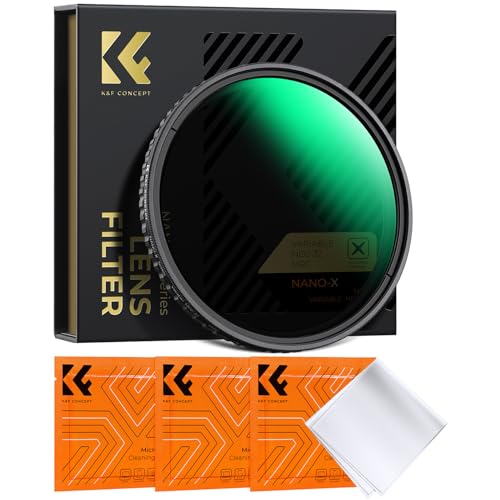
K&F CONCEPT
K&F Concept 82mm Variable ND, 1 to 5 Stops
A 1 to 5 stop range with no cross pattern, which is the safe span for a variable ND: the ugly X appears when you push a wide-range filter to its end.
- Range
- 1 to 5 stops
- Thread
- 82 mm
Use step rings rather than buying one per lens.
Check price
PolarPro
PolarPro 82mm McKinnon VND, 2 to 5 Stops
Hard stops at each end, a deliberately narrow 2 to 5 stop range and cinema-grade glass, which is the combination that keeps colour neutral.
- Range
- 2 to 5 stops
- Stops
- Hard end stops
The pick if you shoot outdoors constantly.
Check price
PolarPro
PolarPro 82mm McKinnon VND, 6 to 9 Stops
The dense half of the pair, for holding a wide aperture at 1/50 in open sun where five stops is not enough.
- Range
- 6 to 9 stops
Owning both beats one very wide filter.
Check priceWhen to break the rule deliberately
A narrower angle, meaning a faster shutter, produces crisper individual frames and a staccato, stuttering motion. This is used deliberately for violence and disorientation, and the well-known battle sequences that popularised it used roughly a 45 degree shutter. It also makes handheld shake far more visible, which is why a fast shutter is a bad accident.
A wider angle, up to 360 degrees, produces heavier blur and a dreamlike smearing. It is genuinely useful in very low light, since it doubles your exposure compared with 180 degrees, and it is a real look for dream sequences and for suggesting intoxication or exhaustion.
Slow motion is the case where the rule quietly changes. Shooting at 120 fps for playback at 24 means each frame will be displayed for five times as long, and a 180 degree shutter at 120 fps is 1/240, which gives sharp frames appropriate for slow motion. That is the rule being followed at the capture frame rate rather than broken.
Frame rate choices and what they mean
Twenty four frames per second is the cinema standard and reads as film. Twenty five is the broadcast standard in fifty hertz regions and looks essentially identical. Thirty reads as slightly more immediate and is common in North American broadcast. Fifty and sixty read as live and are the video look, which is why they are used for sport and disliked for drama.
The decision that matters more is the relationship between capture and delivery. Capturing at 50 or 60 and delivering at 24 or 25 gives you the option of slowing a shot smoothly, which is a real practical benefit and costs you the natural cadence if you use the footage at full speed.
The trap is mixing frame rates in one timeline without planning. Footage captured at 30 dropped into a 24 fps timeline has to have frames removed or blended, and both look wrong on motion. Decide the delivery frame rate first and capture accordingly.
Flicker, and the one hard constraint
Mains electricity cycles at 50 or 60 hertz depending on the region, and many lights, especially cheap LED and fluorescent fixtures, pulse at that rate or a multiple of it. If your shutter interval does not divide evenly into that pulse, each frame catches a different part of the cycle and the footage flickers.
The safe combinations are 1/50 or 1/100 in a 50 Hz region and 1/60 or 1/120 in a 60 Hz region. This is the one situation where the 180 degree rule loses, because flicker is a defect and slightly different motion blur is not. In a 60 Hz region shooting at 24 fps under problem lighting, use 1/60 and accept a 144 degree shutter.
Good quality LED fixtures are flicker-free by design and remove the problem entirely, which is one of the practical reasons to buy proper video lights rather than domestic ones. Screens are a separate case: monitors and phones have their own refresh rates, and a rolling band across a screen in frame is usually fixed by adjusting the shutter in small increments until it stops.
Next, from here
- ND and shutter angle calculator
How many stops your conditions need.
- Frame rate and timecode calculator
Drop frame, non-drop and running time.
- Best variable ND filters
What actually holds 1/50 in daylight.
- Monitoring and exposure tools
Reading exposure once the shutter is fixed.
- ND stops and density chart
Every ND number and what it removes.
- Handheld shooting guide
Why a fast shutter makes shake worse.
Common questions
- What is the 180 degree shutter rule?
- It means setting the shutter so the sensor collects light for half of each frame interval, which produces the motion blur audiences associate with cinema. At 24 frames per second that is 1/48 second, and since most cameras offer 1/50 rather than 1/48 the difference is a twelfth of a stop and invisible. The general rule is to set the shutter to double the frame rate.
- What shutter speed should I use at 60 fps?
- One over 120, which is a 180 degree shutter at that frame rate. The rule is always double the frame rate: 24 fps wants 1/48, 25 wants 1/50, 30 wants 1/60, 60 wants 1/120 and 120 wants 1/240. If you are shooting high frame rates for slow motion, following the rule at the capture frame rate is correct rather than a compromise.
- Why do I need ND filters for video?
- Because the 180 degree rule fixes your exposure time and a cinema body has a native ISO you do not want to leave, so the only remaining control is aperture, which changes the look. At ISO 800 and 1/50 second, full sun needs roughly f/16 to f/22, so a lens at f/2.8 is five to six stops over. An ND filter removes light and changes nothing else.
- When should I break the 180 degree rule?
- For effect or for flicker. A narrower angle around 45 degrees gives crisp, staccato frames used for violence and disorientation, and it also makes handheld shake far more obvious. A wider angle up to 360 degrees gives heavy dreamlike blur and doubles your exposure in very low light. Flicker from mains-powered lighting is the one case where the rule must simply be overridden.
- What shutter speed stops LED flicker?
- In a 50 Hz region use 1/50 or 1/100; in a 60 Hz region use 1/60 or 1/120. Cheap LED and fluorescent fixtures pulse at the mains frequency, and a shutter interval that does not divide evenly into that pulse catches a different part of each cycle. Flicker is a defect while slightly different motion blur is not, so accept the non-standard angle when it happens.
- Should I shoot 24, 25 or 30 frames per second?
- Twenty four for a cinema look, twenty five if you deliver in a 50 Hz broadcast region, and thirty for North American broadcast and a slightly more immediate feel. What matters more is deciding the delivery frame rate before you shoot, because mixing capture rates in one timeline forces frames to be dropped or blended and both look wrong on motion.
Totalling your own rig weight against your gimbal payload? The Camera Rig Build Planner is the paid version of these pages: 8 printable worksheets you fill in with your own numbers, plus the full PDF, $29.