ND Filter Stops Chart: Densities, ND Numbers and Filter Factors
Short answer
ND filters are labelled three different ways for the same thing. ND8 means the filter passes one eighth of the light, which is 3 stops and an optical density of 0.9. The pattern is that the ND number doubles per stop, the density rises by 0.3 per stop, and the stops are what you actually plan with.
ND filters carry three different labelling systems for the same property, which is why a chart is genuinely useful here. A K&F Concept 82mm Variable ND, 1 to 5 Stops covering 1 to 5 stops is the same as ND2 to ND32, the same as density 0.3 to 1.5. The table below converts all three, and the sections after it explain how to choose a density for a given light level.
The complete conversion table
| Stops | ND number | Optical density | Filter factor | Light transmitted |
|---|---|---|---|---|
| 1 | ND2 | 0.3 | 2x | 50% |
| 2 | ND4 | 0.6 | 4x | 25% |
| 3 | ND8 | 0.9 | 8x | 12.5% |
| 4 | ND16 | 1.2 | 16x | 6.25% |
| 5 | ND32 | 1.5 | 32x | 3.13% |
| 6 | ND64 | 1.8 | 64x | 1.56% |
| 7 | ND128 | 2.1 | 128x | 0.78% |
| 8 | ND256 | 2.4 | 256x | 0.39% |
| 9 | ND512 | 2.7 | 512x | 0.20% |
| 10 | ND1000 | 3.0 | 1024x | 0.10% |
| 13 | ND8000 | 3.9 | 8192x | 0.012% |
| 15 | ND32000 | 4.5 | 32768x | 0.003% |
Three patterns make the whole system memorable. The ND number doubles with each stop. The optical density rises by exactly 0.3 per stop, because 0.3 is the base ten logarithm of 2. And the light transmitted halves each time. Once you know any one of the three, the others follow.
How many stops a given condition needs
| Condition | Approximate EV | Stops at f/2.8, ISO 800, 1/50 | ND to use |
|---|---|---|---|
| Deep shade or heavy overcast | 11 to 12 | 0 to 2 | None to ND4 |
| Bright overcast | 13 | 3 | ND8 |
| Hazy sun, subject shaded | 14 | 4 | ND16 |
| Full sun, subject in shade | 14 to 15 | 4 to 5 | ND16 to ND32 |
| Full sun on the subject | 15 to 16 | 6 to 7 | ND64 to ND128 |
| Sun on snow, sand or water | 16 to 17 | 7 to 8 | ND128 to ND256 |
This is the table that explains why one variable ND rarely covers everything. A well-behaved 1 to 5 stop filter handles conditions up to full sun with the subject shaded, and open sun on a bright subject needs six or more. That is the argument for a second denser filter like the PolarPro 82mm McKinnon VND, 6 to 9 Stops rather than one filter with a range that misbehaves at both ends.
Why ND is required at all
A 180 degree shutter fixes your exposure time at half the frame interval, which is 1/48 second at 24 fps and 1/50 at 25. Cinema bodies have a native ISO, commonly 800, that you do not want to leave. That leaves aperture as the only remaining exposure control, and aperture is a creative decision rather than an exposure one.
In full sun at ISO 800 and 1/50, correct exposure lands somewhere around f/16 to f/22. A lens at f/2.8 is therefore five to six stops overexposed, and there is no camera setting that fixes that without changing the motion rendering or the depth of field.
An ND filter removes light and changes nothing else. That is why every serious outdoor shooter owns one, and why internal ND on a camera body is a far more valuable feature than camera reviews suggest.
Filters at these densities
$92 to $250. A wide-range affordable variable, a colour-critical narrow-range variable, and a three-density fixed set.
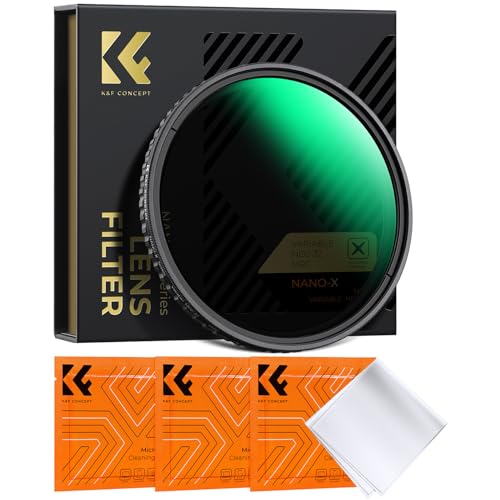
K&F CONCEPT
K&F Concept 82mm Variable ND, 1 to 5 Stops
A 1 to 5 stop range with no cross pattern, which is the safe span for a variable ND: the ugly X appears when you push a wide-range filter to its end.
- Range
- 1 to 5 stops
- Thread
- 82 mm
Use step rings rather than buying one per lens.
Check price
PolarPro
PolarPro 82mm McKinnon VND, 2 to 5 Stops
Hard stops at each end, a deliberately narrow 2 to 5 stop range and cinema-grade glass, which is the combination that keeps colour neutral.
- Range
- 2 to 5 stops
- Stops
- Hard end stops
The pick if you shoot outdoors constantly.
Check price
Hoya
Hoya PRO ND-EX 77mm Kit (ND8, ND64, ND1000)
Three fixed densities rather than a variable, which is what you use when colour accuracy matters more than changing exposure without stopping.
- Densities
- 3, 6 and 10 stops
Slower to work with, cleaner results.
Check priceVariable ND ranges, decoded
Variable filters are labelled by their range in stops or as a span of ND numbers. A filter marked ND2 to ND32 is 1 to 5 stops. One marked ND8 to ND128 is 3 to 7. One marked ND3 to ND1000 claims 1.5 to 10 stops, which is where the trouble starts.
A variable ND is two polarisers rotating against each other, and near the crossed position the transmission across the frame becomes uneven and forms a dark X. Wide-range filters reach that region within their stated travel, so the top third of the range is a specification rather than a usable setting.
This is why the narrow-range filters are the better buy despite covering less. A 2 to 5 stop filter with hard end stops physically cannot be rotated into the bad region, which means every position on it is usable. The full range of a wide filter is not.
Stacking and combining densities
Stops add. An ND8 at 3 stops in front of an ND16 at 4 stops gives 7 stops, or ND128. This is why a three-filter fixed set at 3, 6 and 10 stops covers so much: combining them gives 9, 13 and 16 stops as well as the three individual densities.
What does not add cleanly is colour cast. Two filters with a slight warm shift produce a doubled warm shift, and cheaper filters shift more at higher densities. Stacking two mid-priced NDs can produce a cast that is harder to correct than a single more expensive filter would have been.
Physically, stacking screw-in filters is where vignetting appears. Two stacked filter rings on a wide lens push the front element far enough forward that the frame corners darken. A matte box avoids this entirely by holding both filters in trays that are larger than the lens front.
Thread sizes and step rings
Buy filters at the largest thread size in your kit, usually 82mm, and use step-up rings for everything smaller. Rings cost a few dollars each and one good filter then covers every lens you own, which is far cheaper than a filter per thread.
Never step down. A filter smaller than the lens thread vignettes, badly on a wide lens, and the effect cannot be corrected. Step-up rings only, always, and the filter is always larger than the lens requires.
The one practical cost is that the lens hood no longer fits over the step ring. That matters more than expected when shooting toward a light source, and it is a good argument for a clamp-on matte box, which provides both the filter tray and a flag.
What the numbers do not tell you
- Colour neutrality. Two filters at the same density can shift colour differently, and cheap ones shift more as density rises.
- Infrared contamination. Very dense filters pass infrared that the sensor records, producing a magenta or brown cast in shadows on long exposures.
- Polarisation. Any variable ND polarises, so skies darken unevenly and reflections on glass and water change, and none of that is optional.
- Cross pattern onset. The stated range says nothing about where in that range the X begins.
- Actual density. Cheap filters commonly deviate from their marked value by a third of a stop or more.
- Coating quality. Uncoated glass flares and loses contrast in ways that read as a soft, muddy image.
None of those appear on the specification, which is why price is a rough proxy for filter quality in a way it is not for many other categories. Between two filters at the same density, the more expensive one is usually more neutral and less prone to flare.
Next, from here
- ND and shutter angle calculator
Your conditions, converted to stops.
- Best variable ND filters
The filters at these densities.
- Variable versus fixed ND
Which type suits your workflow.
- Filter thread size chart
Which step rings your kit needs.
- Shutter angle and frame rate
Why exposure time is fixed.
- Best matte boxes
Where fixed densities live.
Common questions
- What does ND8 mean on a filter?
- It means the filter passes one eighth of the light reaching it, which is 3 stops of reduction and an optical density of 0.9. The three labelling systems all describe the same property: the ND number doubles per stop, the density rises 0.3 per stop because 0.3 is the base ten logarithm of 2, and the transmitted light halves.
- How many stops of ND do I need in full sun?
- Six to seven stops at f/2.8, ISO 800 and a 1/50 shutter with the subject in direct sun, which is ND64 to ND128. Full sun with the subject shaded needs four to five. Sun on snow, sand or water can reach eight. Change the aperture or the ISO and the requirement moves, so run your own numbers rather than memorising one figure.
- Do ND filter stops add when stacked?
- Yes. An ND8 at 3 stops in front of an ND16 at 4 stops gives 7 stops in total. That is why a three-filter set at 3, 6 and 10 stops covers so much ground, since combining them also yields 9, 13 and 16. What does not add cleanly is colour cast, and two mid-priced filters together can shift more than one better one.
- What ND number is 10 stops?
- ND1000, which is nominally 1024x and universally labelled 1000 because manufacturers round the marketing figure. Its optical density is 3.0 and it transmits about 0.1 percent of the light reaching it. At that density, infrared contamination becomes a real concern on long exposures, producing a magenta or brown cast in shadows.
- Should I buy one variable ND or a set of fixed ones?
- A variable if light changes during your shots, which describes documentary work. A fixed set if setups are controlled and repeatability matters, which describes narrative work, and a three-density set is cheaper and optically better than a matched pair of premium variables. Many working kits carry both, using the variable on the lens and fixed densities in a matte box tray.
- What filter thread size should I standardise on?
- The largest in your kit, usually 82mm, with step-up rings for everything smaller. One good filter then covers every lens you own for a few dollars per ring. Never step down, because a filter smaller than the lens thread vignettes badly on a wide lens. The main cost is that the lens hood no longer fits over the ring.
Totalling your own rig weight against your gimbal payload? The Camera Rig Build Planner is the paid version of these pages: 8 printable worksheets you fill in with your own numbers, plus the full PDF, $29.