Best Matte Boxes for Camera Rigs in 2026
Short answer
The best matte box for most builds is the Tilta Mirage at around $102, because it takes both 4x5.65 trays and 95mm circular filters and ships with adapter rings from 67mm to 82mm, so one box covers an entire mixed lens set. If you only need a filter tray and a flag on a small rig, the SmallRig clamp-on at $43 does that job for a quarter of the price.
A matte box does two jobs that nothing else does: it holds filters in front of the lens without threading them onto it, and it flags stray light off the front element. The Tilta Mirage Matte Box at around $102 is the pick because it accepts both filter formats and adapts to a mixed lens set. The SmallRig Matte Box with 67 to 82mm Clamp at $43 covers the basics on a small rig, and the Tilta Mirage Pro 114mm Matte Box at $299 is what actual cine glass with a large front diameter needs.
What a matte box is for
The filter tray comes first. Screwing filters onto a lens means one filter per thread size, a stack that vignettes on wide lenses, and no lens hood. A tray takes a 4x5.65 filter that is larger than any front element you own, so it never vignettes, it works on every lens, and swapping a filter takes five seconds without touching the glass.
The flag comes second and is genuinely underrated. The top flag, sometimes called a French flag, blocks light coming from above the frame that would otherwise hit the front element and produce veiling flare, which is the low-contrast wash that makes an image look muddy without any visible artefact. On a backlit exterior a flag is doing more for the picture than most filters.
The third job is stacking. A matte box holds two or three filters at once, so a variable ND and a diffusion can both be in the light path with a defined order and no thread stacking, and either can be removed independently.
Where most buyers should look
$43 to $369. A basic clamp-on, the flexible mid option, and the same box bundled with a 95mm variable ND.

SMALLRIG
SmallRig Matte Box with 67 to 82mm Clamp
A clamp-on box with a 4x5.65 tray and a top flag, which is the cheapest way to get a real filter tray and flare control in front of a lens.
- Tray
- 4 x 5.65 in
- Clamp
- 67 to 82 mm
Clamp-on only, so it needs a matching thread.
Check price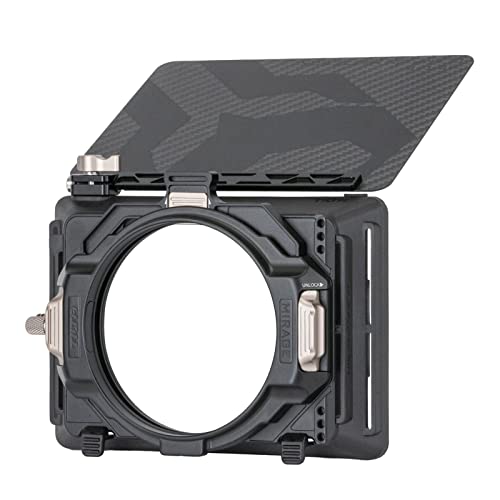
Tilta
Tilta Mirage Matte Box
Takes both 4x5.65 trays and 95mm circular filters with adapter rings down to 67mm, so one box covers a whole mixed set of lenses.
- Filters
- 4x5.65 and 95mm round
- Rings
- 67 to 82 mm
The pick for a small narrative kit.
Check price
Tilta
Tilta Mirage Matte Box VND Kit
The Mirage with a 95mm variable ND built into the kit, which replaces a separate screw-on VND and keeps exposure control behind the flag.
- Includes
- 95mm VND
Cheaper than the box plus a good VND bought apart.
Check priceClamp-on or rod-mounted
A clamp-on box grips the lens filter thread or the barrel directly. It is light, fast to fit, needs no rods and no baseplate, and it moves with the lens so it can never be misaligned. The cost is that its whole weight hangs on the front of the lens, which on a small lens with a plastic filter thread is a genuine stress, and it has to be removed and refitted at every lens change.
A rod-mounted box sits on 15mm rods below the lens and is positioned once. Lens changes happen without touching it, it carries far more weight safely, and it can take a larger backing. The cost is that it needs a baseplate and rods, which is another $50 of rigging, and it has to be realigned when the lens length changes.
The honest rule: clamp-on for a run and gun rig with one or two lenses, rod-mounted for a narrative build with a matched set. The SmallRig Baseplate Kit with 15mm Rod Clamp and SmallRig 15mm Carbon Fibre Rods, 12 inch pair pair is around $50 together and is what a rod-mounted box needs underneath it.
Filter formats and backing sizes
| Format | Size | What it suits |
|---|---|---|
| 4 x 5.65 in tray | The industry standard rectangular filter | Almost everything. Buy this format |
| 4 x 4 in tray | Older square standard, slightly smaller | Legacy filters. Do not start here |
| 95mm circular | Round filters in a cartridge | Fast swaps, rotating filters like a polariser |
| 114mm backing | The opening the box presents to the lens | Cine primes and zooms with large fronts |
| Clamp 67 to 82mm | The range of lens threads it grips | Stills lenses and small cine primes |
The backing size is the number that catches people out. A box with an 80mm backing physically cannot clamp onto a lens with a 95mm front, and no adapter fixes that because the problem is the size of the opening. Check the front diameter of the largest lens you own, or plan to own, before choosing a box. That is the whole reason the Tilta Mirage Pro 114mm Matte Box with its 114mm backing exists.
For cine glass and rod mounting
A 114mm carbon box for large-front lenses, a spare tray so two filters stay loaded, and the baseplate that rods clamp into.

Tilta
Tilta Mirage Pro 114mm Matte Box
Carbon fibre with a 114mm backing, which is the size cine primes and zooms actually need once the front diameter grows past 95mm.
- Backing
- 114 mm
- Body
- Carbon fibre
Pointless on small mirrorless glass.
Check price
K&F CONCEPT
K&F Concept 4x5.65 Filter Tray
A spare tray means the diffusion and the ND both stay mounted, so a change is a swap rather than a rebuild.
- Size
- 4 x 5.65 in

SMALLRIG
SmallRig Baseplate Kit with 15mm Rod Clamp
The baseplate and rods that a matte box, follow focus and lens support all hang from, so it is the part to buy before any of those.
- Rods
- 15 mm LWS
Buy this before a matte box.
Check priceFilter order, and why it matters
When two filters are stacked, the one closer to the lens acts on light that has already passed through the outer one. In practice the order that works is diffusion closest to the lens, ND furthest out. Diffusion scatters light, and scattering already-attenuated light produces a more controlled bloom than attenuating already-scattered light.
A polariser, if you use one, goes outermost of all, because it needs to be rotated and rotating it should not disturb anything else. On a variable ND, remember that you already have two polarisers in the path, and adding a third produces unpredictable results.
Keep the trays clean and keep the unused tray in the box rather than in a pocket. A K&F Concept 4x5.65 Filter Tray spare at around $23 means the ND and the diffusion each live permanently in their own tray, so a change is a swap rather than an unmounting operation with fingerprints involved.
When you do not need a matte box
If you shoot handheld documentary with one autofocus zoom, a screw-in variable ND and the lens hood do most of what a matte box does, at a fraction of the weight and with nothing to knock. The run and gun starter build leaves the matte box out deliberately for that reason.
If your camera has internal ND, like the Blackmagic Pocket Cinema Camera 6K Pro or the Canon EOS C70, the strongest argument for a matte box disappears. What remains is the flag and the ability to run diffusion, both of which are real but neither of which is urgent.
And if your rig is on a gimbal near its payload limit, a matte box is several hundred grams high and forward, which is the worst possible place to add mass. Check the gimbal payload calculator before committing to one.
How we chose
These picks come from published backing and clamp specifications, stated tray formats, included adapter rings, materials, and verified owner reviews describing fit and light leaks. We did not have every one of these boxes in our hands and will not pretend otherwise.
The criteria in order: what filter formats it takes, what lens front diameters it will actually clamp to, whether it mounts on rods as well as clamping, and how well the flag adjusts. Weight mattered on gimbal builds and mattered very little on sticks.
Next, from here
- Matte box and filtration guide
Trays, stacking, flags and flare.
- Best diffusion filters
The tray filter people buy a box for.
- Best variable ND filters
The screw-in alternative, and its limits.
- 15mm versus 19mm rods
Which rod standard a box clamps to.
- Best cine lenses
Front diameter decides which box fits.
- Narrative starter build
Where a first matte box belongs.
Common questions
- Do I really need a matte box?
- Only if you use filters on more than one lens, or if you shoot toward light sources regularly. A tray holds one filter that fits every lens and never vignettes, and the flag suppresses veiling flare that muddies contrast without producing a visible artefact. For a single-lens documentary rig with a screw-in variable ND and a lens hood, a matte box is weight without much return.
- Clamp-on or rod-mounted matte box?
- Clamp-on for a small rig with one or two lenses: it is light, needs no rods and can never be misaligned because it moves with the lens. Rod-mounted for a narrative build with a matched set, because lens changes happen without touching the box and it can carry far more weight safely. A rod-mounted box needs a baseplate and 15mm rods, which is roughly $50 of extra rigging.
- What filter size should I buy for a matte box?
- Four by 5.65 inches, which is the industry standard rectangular format and what nearly every current box accepts. Older 4 by 4 inch filters exist and there is no reason to start there. Round 95mm filters in a cartridge are useful for anything you need to rotate, such as a polariser, and some boxes accept both formats, which is a genuine convenience on a mixed kit.
- What is a matte box backing size?
- It is the diameter of the opening the box presents toward the lens, and it is a hard limit. A box with an 80mm backing physically cannot clamp onto a lens with a 95mm front, and no adapter ring solves that because the opening itself is too small. Check the front diameter of the largest lens you own or plan to own before choosing a box.
- What order should filters go in a matte box?
- Diffusion closest to the lens, ND further out, and a polariser outermost of all so it can be rotated without disturbing anything else. Diffusion scatters light, and scattering already-attenuated light gives a more controlled bloom than the reverse. Note that a variable ND already contains two polarisers, so adding a third polariser to the stack produces unpredictable results.
- Does a matte box help if my camera has internal ND?
- Less, and that is a real argument for buying such a camera. Internal ND removes the strongest reason to own a box, since it never vignettes and works identically on every lens. What remains is the top flag, which suppresses veiling flare on backlit shots, and the ability to run diffusion in a tray. Both are worth having and neither is urgent.
Totalling your own rig weight against your gimbal payload? The Camera Rig Build Planner is the paid version of these pages: 8 printable worksheets you fill in with your own numbers, plus the full PDF, $29.