Best Variable ND Filters for Video in 2026
Short answer
The best variable ND for most people is the K&F Concept 82mm at 1 to 5 stops for around $92, because a narrow range avoids the cross pattern that ruins wide-range filters and five stops covers most daylight at f/2.8 and 1/50. If colour accuracy matters, the PolarPro McKinnon 2 to 5 stop at $250 has hard end stops and cinema-grade glass.
A variable ND is what lets you shoot at f/2.8 and a 180 degree shutter in daylight, which is the whole reason a fast lens is worth owning. The K&F Concept 82mm Variable ND, 1 to 5 Stops at around $92 is the pick because its 1 to 5 stop range stays inside the region where a variable ND behaves. The PolarPro 82mm McKinnon VND, 2 to 5 Stops at $250 buys neutral colour and hard stops, and owning it alongside the PolarPro 82mm McKinnon VND, 6 to 9 Stops is the professional answer that avoids wide-range compromise entirely.
How a variable ND works, and why that explains every problem
A variable ND is two linear polarisers stacked with one rotating against the other. When their axes align, most light passes. As you rotate toward crossed, less and less passes. That single mechanism produces every advantage and every fault the category has.
The advantage is continuous adjustment: no filter changes, no stopping the take, just a twist to match the light. The faults all come from the same physics. Near the crossed position, the transmission across the frame becomes uneven and the classic dark X appears, because the effective polarisation angle differs across a wide field of view. Colour shifts because the two polarisers do not attenuate all wavelengths equally. And because it is a polariser, it also polarises: skies darken unevenly, reflections on water and glass change, and none of that is optional.
This is why range is the specification that matters. A filter advertised at 1 to 10 stops is behaving well for maybe half of that travel and producing a cross for the rest. A filter that only goes to 5 stops has been designed to stay inside the region where the physics is well behaved.
Where most buyers should look
$92 to $120. Two threaded filters with sensible ranges, and one magnetic system for people who swap constantly.
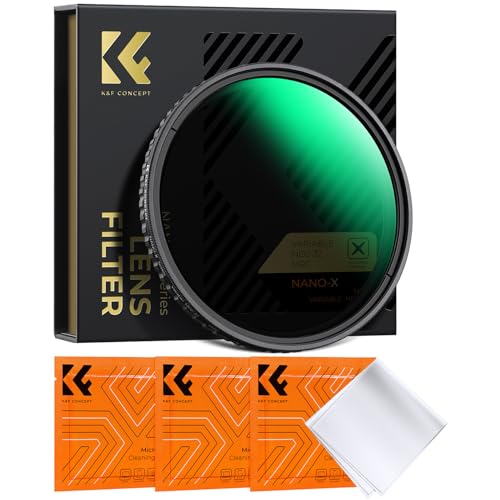
K&F CONCEPT
K&F Concept 82mm Variable ND, 1 to 5 Stops
A 1 to 5 stop range with no cross pattern, which is the safe span for a variable ND: the ugly X appears when you push a wide-range filter to its end.
- Range
- 1 to 5 stops
- Thread
- 82 mm
Use step rings rather than buying one per lens.
Check price
Tiffen
Tiffen 82mm Variable ND, 2 to 8 Stops
A wider 2 to 8 stop span from a filter maker that supplies actual film sets, at the cost of more colour shift at the dense end.
- Range
- 2 to 8 stops
Watch the far end in mixed light.
Check price
Kase
Kase Wolverine Magnetic 82mm VND Kit
Magnetic mounting with a 1.5 to 10 stop range and a CPL, which is genuinely faster to change than threads when a lens swap is mid-scene.
- Range
- 1.5 to 10 stops
- Mount
- Magnetic
Magnets add a stack in front of wide lenses.
Check priceWhy the 180 degree shutter rule forces this purchase
The conventional motion blur of cinema comes from a shutter open for half of each frame interval, which at 24 fps means a 1/48 second exposure and at 25 fps means 1/50. That is a fixed exposure time, and it is far longer than daylight wants. On a sunny day at ISO 800, which is the native rating on many cinema bodies, correct exposure at 1/50 needs something like f/22, and no fast lens has that.
You have three ways out. Stop down, which kills the shallow depth of field you bought the lens for and eventually hits diffraction. Raise the shutter speed, which changes the motion rendering into something that reads as stuttery and video-like. Or put an ND filter in front, which changes nothing except the amount of light.
The third option is the only one with no cost to the image, which is why every narrative and documentary shooter owns ND. The ND filter and shutter angle calculator works out exactly how many stops you need for a given light level, ISO and aperture.
How many stops you actually need
| Condition | Approximate light level | Stops needed at f/2.8, ISO 800, 1/50 |
|---|---|---|
| Deep shade or overcast | EV 11 to 12 | 0 to 2 stops |
| Bright overcast | EV 13 | 3 stops |
| Hazy sun | EV 14 | 4 stops |
| Full sun, subject in shade | EV 14 to 15 | 4 to 5 stops |
| Full sun on the subject | EV 15 to 16 | 6 to 7 stops |
| Sun on snow, sand or water | EV 16 to 17 | 7 to 8 stops |
This is why a 1 to 5 stop filter is enough for most work and not for all of it. Open sun on a bright subject genuinely needs six or more, which is the argument for owning a second, denser filter like the PolarPro 82mm McKinnon VND, 6 to 9 Stops rather than buying one filter with a range that misbehaves at both ends. Run your own numbers rather than trusting a rule of thumb, since ISO and aperture move this table considerably.
The colour-critical options
$219 to $250. Two narrow-range filters designed to be owned as a pair, and a fixed-density set for when neutrality beats convenience.

PolarPro
PolarPro 82mm McKinnon VND, 2 to 5 Stops
Hard stops at each end, a deliberately narrow 2 to 5 stop range and cinema-grade glass, which is the combination that keeps colour neutral.
- Range
- 2 to 5 stops
- Stops
- Hard end stops
The pick if you shoot outdoors constantly.
Check price
PolarPro
PolarPro 82mm McKinnon VND, 6 to 9 Stops
The dense half of the pair, for holding a wide aperture at 1/50 in open sun where five stops is not enough.
- Range
- 6 to 9 stops
Owning both beats one very wide filter.
Check price
Hoya
Hoya PRO ND-EX 77mm Kit (ND8, ND64, ND1000)
Three fixed densities rather than a variable, which is what you use when colour accuracy matters more than changing exposure without stopping.
- Densities
- 3, 6 and 10 stops
Slower to work with, cleaner results.
Check priceFixed ND, and when to prefer it
A fixed ND is a single sheet of neutral glass with no polarisers in it, which means no cross pattern, no polarisation effects and far better colour neutrality. The Hoya PRO ND-EX 77mm Kit (ND8, ND64, ND1000) gives you 3, 6 and 10 stops for around $219, and each of those is optically better than any variable at the same density.
The cost is workflow. Changing density means unscrewing one filter and screwing on another, which takes half a minute and cannot be done mid-take. On a controlled set where the light does not change between setups, that is not a cost at all, which is why narrative work uses fixed ND in a matte box tray and documentary work uses a variable on the lens.
The hybrid answer that a lot of working shooters land on: a variable ND for run and gun, a set of fixed NDs in trays for anything on sticks, and a matte box that takes both. The Tilta Mirage Matte Box VND Kit is precisely that compromise built into one product.
Buying one filter instead of five
Buy the filter to fit your largest lens thread, which for most kits is 82mm, then use step-up rings for everything smaller. A set of rings costs a few dollars each and means one good filter covers every lens you own.
Never step down. A filter smaller than the lens thread will vignette, and on a wide lens it will vignette badly. Step-up rings only, always.
The practical downside is that the lens hood no longer fits over the ring, which matters more than people expect when shooting toward a light source. A SmallRig Matte Box with 67 to 82mm Clamp matte box at around $43 solves that and adds a filter tray, and it is often a better purchase than a second filter.
How we chose
These picks come from published density ranges, stated glass and coating specifications, manufacturer statements on colour neutrality, and verified owner reviews describing cross patterns and colour casts in real conditions. We did not have every one of these filters in our hands and will not pretend otherwise.
The criteria in order: does the stated range stay inside well-behaved territory, does it have hard end stops so you cannot rotate into the cross, how neutral is the colour, and how well made is the rotating mechanism. Price mattered less than range discipline, because a cheap filter with a sensible range beats an expensive one pushed too far.
Next, from here
- ND and shutter angle calculator
How many stops your conditions actually need.
- ND stops and density chart
ND numbers, stops and filter factors in one table.
- Variable versus fixed ND
The full head to head, by workflow.
- Best matte boxes
Where fixed ND actually lives.
- Shutter angle and frame rate
Why 1/50 is not negotiable.
- Filter thread size chart
Which step rings your kit needs.
Common questions
- Why does my variable ND show a dark X across the frame?
- Because it is two polarisers and you have rotated them close to crossed. Near that position the effective polarisation angle varies across a wide field of view, so transmission becomes uneven and forms the classic X. It gets worse on wider lenses. The fix is to stay within the first two thirds of the filter travel, which is exactly why a 1 to 5 stop filter is a better buy than a 1 to 10 stop one.
- How many stops of ND do I actually need?
- At f/2.8, ISO 800 and a 1/50 shutter, bright overcast needs about 3 stops, hazy sun about 4, and full sun on the subject 6 to 7. Sun on snow or water can reach 8. That is why one filter rarely covers everything: a well-behaved 2 to 5 stop filter handles most days, and a second 6 to 9 stop filter covers open sun without pushing either one into its bad region.
- Is a variable ND or a fixed ND better?
- Fixed ND is optically better in every respect: no cross pattern, no polarisation side effects and far better colour neutrality. Variable ND is better for workflow, because you adjust it while rolling instead of unscrewing one filter for another. Documentary work uses variable on the lens, narrative work uses fixed in a matte box tray, and a lot of working kits carry both.
- Do I need a different ND filter for each lens?
- No. Buy one filter sized to your largest thread, usually 82mm, and use step-up rings for everything smaller. Rings cost a few dollars each. Never step down, because a filter smaller than the lens thread will vignette, badly on a wide lens. The one real downside is that the lens hood no longer fits, which is a good argument for a clamp-on matte box instead.
- Why does my variable ND make skies look uneven?
- Because a variable ND is built from polarisers, so it polarises whether you want it to or not. Blue sky is naturally polarised in a band roughly ninety degrees from the sun, so part of the sky darkens more than the rest, and on a wide lens that gradient is visible in frame. Nothing removes it except using a fixed ND instead, or reframing so less sky is included.
- Do I need a variable ND if my camera has internal ND?
- Generally no, and that is one of the strongest arguments for bodies that have it. Internal ND sits behind the lens, so it never vignettes, never polarises and works identically on every lens you mount. If your camera has it, spend the filter budget on diffusion instead. If it does not, a variable ND is effectively a required purchase for outdoor work.
Totalling your own rig weight against your gimbal payload? The Camera Rig Build Planner is the paid version of these pages: 8 printable worksheets you fill in with your own numbers, plus the full PDF, $29.