Filter Thread Sizes Chart: Common Threads, Step Rings and Matte Box Backings
Short answer
Standardise on the largest filter thread in your kit, usually 82mm, and use step-up rings for every smaller lens. One filter then covers everything, since a step-up ring means the filter is always larger than the lens requires. Never step down, because a filter smaller than the thread vignettes and the effect cannot be corrected.
Filter threads are the most avoidable source of wasted money in a camera kit, because people buy one filter per lens instead of one filter plus rings. Standardise at 82mm with a K&F Concept 82mm Variable ND, 1 to 5 Stops and step up to it, or sidestep threads entirely with a Tilta Mirage Matte Box that takes trays larger than any lens front. The tables below cover both routes.
Common filter thread sizes
| Thread | Typical lenses | Notes |
|---|---|---|
| 37 mm | Compact crop primes, some Micro Four Thirds | Rarely worth a dedicated filter |
| 46 mm | Small primes, pancake lenses | Step up from here |
| 49 mm | Older 50mm primes | Very common on vintage glass |
| 52 mm | Kit zooms, many Nikon primes | Common on older systems |
| 55 mm | Some crop zooms | Step up |
| 58 mm | Canon kit lenses | Very common |
| 62 mm | Mid-range crop zooms | Common |
| 67 mm | Many f/2.8 crop zooms | The smallest common matte box clamp size |
| 72 mm | Full frame primes and mid zooms | Common |
| 77 mm | Full frame f/2.8 zooms, many telephotos | The old professional standard |
| 82 mm | Current full frame f/2.8 zooms | The current professional standard |
| 95 mm | Cine primes, large telephotos | Beyond most screw-in filter ranges |
| 114 mm | Cine zooms and large cine primes | Matte box territory only |
Two of those are decision points rather than sizes. At 82mm, standardise: it is the largest common screw-in thread and step-up rings reach it from everywhere below. At 95mm and above you are into cine glass, screw-in filters largely stop being practical, and a matte box with the right backing becomes the only sensible answer.
Step rings, and the rule that matters
A step-up ring adapts a smaller lens thread to a larger filter. A 67 to 82mm ring lets an 82mm filter fit a 67mm lens, and because the filter is larger than the lens needs, it cannot vignette. This is the correct direction and the only one you should use.
A step-down ring adapts a larger lens thread to a smaller filter, which puts a filter smaller than the lens opening in front of it. On any lens wider than a moderate telephoto this vignettes, and the darkening at the corners cannot be corrected afterwards. Step-down rings exist and are almost always the wrong purchase.
The practical kit is one filter at 82mm plus rings at 67, 72 and 77mm, which together cover essentially every lens a modern kit contains. That is under twenty dollars of rings against several hundred dollars of duplicate filters.
The step ring combinations worth owning
| Ring | Covers | Why |
|---|---|---|
| 67 to 82 mm | Constant aperture crop zooms | The most used ring in most kits |
| 72 to 82 mm | Full frame primes and mid zooms | Common on prime sets |
| 77 to 82 mm | Older professional zooms | Bridges the old standard to the new one |
| 62 to 82 mm | Mid-range crop zooms | Worth having if you own one |
| 58 to 82 mm | Kit lenses | Only if a kit lens stays in the bag |
| 52 to 82 mm | Vintage and older primes | Large jump. Watch the hood clearance |
The larger the jump, the further forward the filter sits, which affects hood clearance and can slightly increase flare on a lens whose front element was recessed. It does not vignette, since the filter is still larger than the aperture, but it is a reason to prefer the smallest ring that reaches rather than always stepping from the smallest lens.
Both routes
$43 to $102. An 82mm screw-in filter to standardise on, and two matte boxes that clamp over a range of threads and take trays instead.
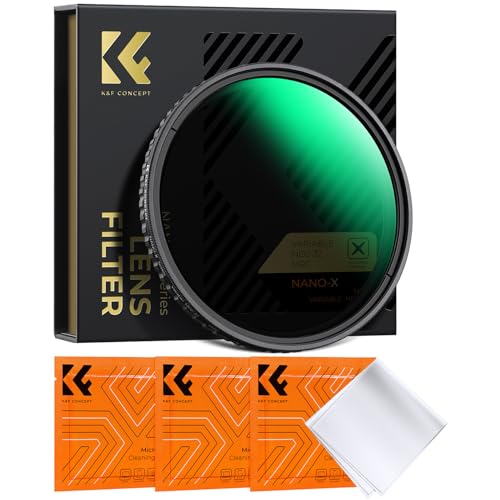
K&F CONCEPT
K&F Concept 82mm Variable ND, 1 to 5 Stops
A 1 to 5 stop range with no cross pattern, which is the safe span for a variable ND: the ugly X appears when you push a wide-range filter to its end.
- Range
- 1 to 5 stops
- Thread
- 82 mm
Use step rings rather than buying one per lens.
Check price
SMALLRIG
SmallRig Matte Box with 67 to 82mm Clamp
A clamp-on box with a 4x5.65 tray and a top flag, which is the cheapest way to get a real filter tray and flare control in front of a lens.
- Tray
- 4 x 5.65 in
- Clamp
- 67 to 82 mm
Clamp-on only, so it needs a matching thread.
Check price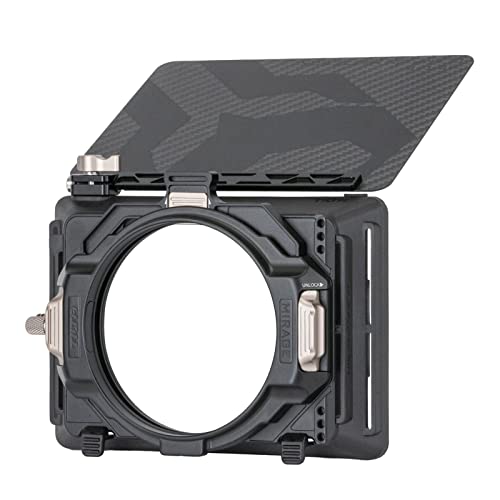
Tilta
Tilta Mirage Matte Box
Takes both 4x5.65 trays and 95mm circular filters with adapter rings down to 67mm, so one box covers a whole mixed set of lenses.
- Filters
- 4x5.65 and 95mm round
- Rings
- 67 to 82 mm
The pick for a small narrative kit.
Check priceMatte box backings and clamp ranges
| Backing or clamp | Fits lens fronts up to | Suits |
|---|---|---|
| 67 to 82 mm clamp | 82 mm | Stills lenses and small cine primes |
| 80 mm backing | 80 mm | Compact cine primes |
| 95 mm backing | 95 mm | Most affordable cine prime sets |
| 114 mm backing | 114 mm | Cine zooms and larger cine primes |
| 143 mm backing | 143 mm | Large format and anamorphic |
This is the specification that catches people out. A box with an 80mm backing physically cannot clamp onto a lens with a 95mm front, and no adapter solves it because the opening itself is too small. Check the front diameter of the largest lens you own or plan to own before choosing a box.
Tray formats
Four by 5.65 inches is the industry standard rectangular filter and what nearly every current matte box accepts. Buy this format. It is larger than any lens front, so it never vignettes, and it works on every lens regardless of thread.
Four by four inches is an older square standard that still appears on secondhand filters. It is slightly smaller and there is no reason to start a collection there, although a 4x4 filter will sit in some 4x5.65 trays with an insert.
Ninety five millimetre round filters in a cartridge are the third format, used for anything that needs rotating such as a polariser, and for fast swaps. Boxes that take both square trays and round cartridges are genuinely more flexible on a mixed kit, which is why the Tilta Mirage Matte Box is the recommendation for a small production.
A practical filter buying order
- Identify the largest thread in your current kit. For most modern kits this is 82mm.
- Buy one good variable ND at that size, and use it as the reference for everything else.
- Buy step-up rings from every other thread you own to that size. Under twenty dollars total.
- Add a matte box when you want a flag, a second filter in the path, or lenses above 82mm.
- Once you have a box, buy 4x5.65 trays rather than more screw-in filters.
- Add a spare tray so the ND and the diffusion can both stay mounted permanently.
That order avoids the two common wastes: buying a filter per lens, and buying an expensive matte box before knowing which lenses will actually live in front of it. A K&F Concept 4x5.65 Filter Tray spare at around $23 is the last item and it is the one that makes a filter change take five seconds instead of thirty.
Next, from here
- ND stops and density chart
What to put in those threads.
- Best matte boxes
Backings, clamps and tray formats.
- Matte box and filtration guide
Trays, stacking and flags.
- Best variable ND filters
The filter most kits standardise on.
- Best diffusion filters
The other tray filter worth owning.
- Best cine lenses
Where front diameters get large.
Common questions
- What filter thread size should I buy?
- The largest in your kit, which on a modern set is usually 82mm, then step up to it from every smaller lens. One good filter plus a handful of rings covers everything you own for a fraction of what a filter per lens costs. Rings are a few dollars each and the filter is always larger than the lens needs.
- What is the difference between a step-up and a step-down ring?
- A step-up ring fits a larger filter to a smaller lens thread, which is correct because the filter is then larger than the lens opening. A step-down ring fits a smaller filter to a larger thread, which puts a filter smaller than the opening in front of the lens and vignettes on anything wider than a moderate telephoto. Use step-up only.
- What is a matte box backing size?
- The diameter of the opening the box presents toward the lens, and it is a hard limit rather than something an adapter can fix. A box with an 80mm backing cannot clamp onto a lens with a 95mm front. Cine primes commonly have 95mm or 114mm fronts, so check your largest lens before choosing a box.
- What filter tray size should I use?
- Four by 5.65 inches, which is the industry standard rectangular format that nearly every current matte box accepts. It is larger than any lens front so it never vignettes, and it works on every lens regardless of thread size. Older 4x4 inch filters still exist and there is no reason to start a collection at that size.
- Does a large step-up ring cause problems?
- Not vignetting, since the filter is still larger than the aperture, but it does push the filter further forward, which affects lens hood clearance and can slightly increase flare on a lens with a recessed front element. Prefer the smallest ring that reaches, and be aware that the lens hood will usually no longer fit once any ring is fitted.
- Should I use screw-in filters or a matte box?
- Screw-in with step-up rings if you have one or two lenses and want minimum weight, which suits run and gun work. A matte box once you want a flag for backlit shots, a second filter in the path, or lenses with fronts above 82mm. A basic clamp-on box costs around $43, which is often less than a second screw-in filter.
Totalling your own rig weight against your gimbal payload? The Camera Rig Build Planner is the paid version of these pages: 8 printable worksheets you fill in with your own numbers, plus the full PDF, $29.