Variable ND vs Fixed ND: Which Filter Your Workflow Needs
Short answer
Fixed ND is optically better in every respect, with no cross pattern, no polarisation side effects and better colour neutrality. Variable ND is better for workflow, because it adjusts while rolling. Documentary work uses variable on the lens, narrative work uses fixed in a matte box tray, and many working kits carry both.
This is a workflow decision disguised as an optics decision. A PolarPro 82mm McKinnon VND, 2 to 5 Stops adjusts continuously while rolling and is built from two polarisers, which is where all of its faults come from. A Hoya PRO ND-EX 77mm Kit (ND8, ND64, ND1000) gives you three known densities with no polarisers at all, which is optically cleaner and cannot be changed mid-take. Which one is right depends entirely on whether your light changes during a shot.
How each one works
A fixed ND is a single sheet of neutral glass or resin that absorbs a defined amount of light across the spectrum. That is the whole mechanism. There is nothing rotating, nothing polarising, and no interaction with the angle of incoming light, which is why a fixed ND is optically about as clean as putting a piece of glass in front of a lens can be.
A variable ND is two linear polarisers stacked, with one rotating against the other. When their axes align, most light passes; as they approach crossed, less does. Every advantage and every fault of the category comes from that one mechanism.
The advantage is continuous adjustment with no filter change. The faults are the cross pattern near the crossed position, colour shift because the polarisers do not attenuate all wavelengths equally, and the fact that a polariser polarises: skies darken unevenly and reflections on glass and water change.
The comparison
| Variable ND | Fixed ND | |
|---|---|---|
| Adjustment | Continuous, while rolling | None. Change the filter |
| Cross pattern | Yes, near the dense end | Never |
| Colour neutrality | Good to fair, degrades with density | Excellent |
| Polarisation effects | Always present | None |
| Repeatability | Poor. Set by feel | Exact. Density is a number |
| Cost for full coverage | One or two filters, $92 to $500 | Three filters, about $219 |
| Best for | Changing light, run and gun | Controlled setups, narrative |
The repeatability row is the one that decides narrative work. A setup shot at ND64 can be matched exactly on a pickup day a week later. A setup shot at "roughly two thirds round on the variable" cannot, and the mismatch between a wide and a close-up filmed with different variable positions is a real and hard-to-diagnose problem in the edit.
Why the cross pattern appears
When the two polarisers approach the crossed position, the effective polarisation angle differs across a wide field of view, so transmission becomes uneven and forms an X across the frame. It gets worse on wider lenses because the range of angles is larger.
This is physics rather than a manufacturing defect, which is why a filter advertised at 1 to 10 stops is misleading. It behaves well for maybe the first two thirds of its travel and produces a cross for the rest, and the wide range is a marketing figure rather than a usable one.
The good manufacturers respond by restricting range and adding hard end stops so you physically cannot rotate into the bad region. That is why the PolarPro 82mm McKinnon VND, 2 to 5 Stops and PolarPro 82mm McKinnon VND, 6 to 9 Stops exist as a pair rather than as one wide-range filter, and it is a design decision worth paying for.
Both approaches
$92 to $250. An affordable narrow-range variable, a colour-critical variable, and a three-density fixed set.
K&F CONCEPT
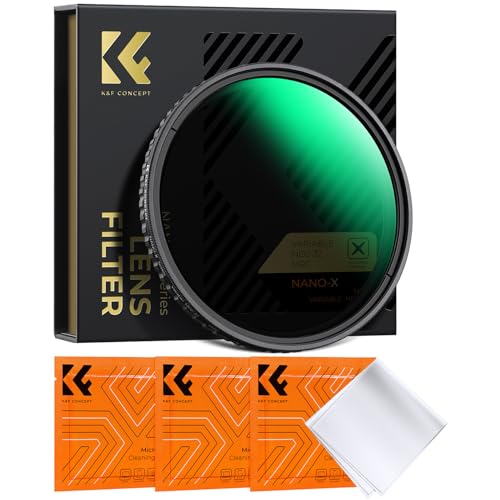
K&F Concept 82mm Variable ND, 1 to 5 Stops
A 1 to 5 stop range with no cross pattern, which is the safe span for a variable ND: the ugly X appears when you push a wide-range filter to its end.
- Range
- 1 to 5 stops
- Thread
- 82 mm
Use step rings rather than buying one per lens.
Check price
PolarPro
PolarPro 82mm McKinnon VND, 2 to 5 Stops
Hard stops at each end, a deliberately narrow 2 to 5 stop range and cinema-grade glass, which is the combination that keeps colour neutral.
- Range
- 2 to 5 stops
- Stops
- Hard end stops
The pick if you shoot outdoors constantly.
Check price
Hoya
Hoya PRO ND-EX 77mm Kit (ND8, ND64, ND1000)
Three fixed densities rather than a variable, which is what you use when colour accuracy matters more than changing exposure without stopping.
- Densities
- 3, 6 and 10 stops
Slower to work with, cleaner results.
Check priceThe workflow difference in practice
On a documentary shoot, a subject walks from a window-lit room into a hallway during a shot. That is a three stop change happening while you are rolling, and a variable ND is the only tool that lets you follow it without stopping. That single scenario justifies the whole category.
On a narrative set, the light does not change during a take, because you made it and you control it. Filter changes happen between setups, when the crew is resetting anyway, and the value shifts entirely to optical quality and repeatability. A tray filter in a matte box is changed in five seconds.
The hybrid that many working shooters land on is a variable on the lens for reactive work and a fixed set in trays for anything on sticks. The Tilta Mirage Matte Box VND Kit is that compromise built into one product: a matte box with a 95mm variable ND in it, so you get the tray system and the continuous adjustment together.
Cost, honestly compared
One good variable covering 2 to 5 stops is around $250, and a second covering 6 to 9 stops takes you to $500 for full daylight coverage without pushing either filter into its bad region. A budget variable like the K&F Concept 82mm Variable ND, 1 to 5 Stops at $92 covers most conditions honestly at a lower optical standard.
A three-filter fixed set at 3, 6 and 10 stops is around $219 and covers essentially every daylight condition with better optics than any variable at the same price. On pure cost per stop of usable coverage, fixed wins clearly.
What fixed does not include is a matte box to put them in, since screw-in fixed NDs bring back the one-per-thread-size problem. Adding a SmallRig Matte Box with 67 to 82mm Clamp at around $43 is the honest total, and even then the fixed route is cheaper than a matched pair of premium variables.
The verdict
- Reactive documentary work where light changes during shots: variable, narrow range, hard stops.
- Narrative or commercial work with controlled setups: fixed, in a matte box tray, with the density recorded.
- A camera with internal ND: neither is urgent. Spend the money on diffusion instead.
- Gimbal work: variable on the lens, because a matte box is mass in the worst possible place.
- Anything with a sky or water in frame that must not change: fixed, because a variable polarises whether you want it to or not.
- A kit doing both kinds of work: both, which is what most working shooters end up owning.
The internal ND line deserves emphasis. A body with built-in ND sidesteps this entire decision, never vignettes and works identically on every lens. It is one of the most undervalued specifications in any camera comparison, and it quietly saves several hundred dollars of filters.
Next, from here
- Best variable ND filters
The variables, compared.
- ND and shutter angle calculator
How many stops you need.
- ND stops and density chart
Every ND number in one table.
- Best matte boxes
Where fixed ND actually lives.
- Shutter angle and frame rate
Why ND is required at all.
- Matte box and filtration guide
Trays, stacking and flags.
Common questions
- Is a variable ND or a fixed ND better?
- Fixed is optically better in every respect: no cross pattern, no polarisation side effects and better colour neutrality. Variable is better for workflow because it adjusts while rolling. Documentary work uses variable on the lens, narrative work uses fixed in a matte box tray, and a lot of working kits carry both because they serve different situations.
- Why does my variable ND show a dark X?
- Because it is two polarisers and you have rotated toward the crossed position, where the effective polarisation angle varies across a wide field of view and transmission becomes uneven. It is physics rather than a defect, it worsens on wide lenses, and the fix is a filter with a restricted range and hard end stops so you cannot rotate into it.
- How many fixed ND filters do I need?
- Three covers essentially every daylight condition: around 3 stops for overcast, 6 for bright conditions, and 10 for full sun with a wide aperture. A kit at those densities is around $219, which is less than a matched pair of premium variables and optically better. What it does not include is the matte box or step rings to mount them.
- Can I use fixed ND for run and gun work?
- You can, and the workflow fights you. A subject walking from a window-lit room into a hallway is a three stop change during the shot, and a fixed filter cannot follow it. Fixed ND belongs in situations where the light does not change during a take and filter changes happen between setups while the crew resets anyway.
- Why does repeatability matter for ND filters?
- Because a scripted scene is shot from several angles, sometimes on different days, and those pieces must cut together. A fixed density is a number you can write down and match exactly. A variable ND is set by feel and cannot be returned to precisely, so a two thirds of a stop difference between the wide and the close-up shows up as an exposure and colour mismatch.
- Do I need either if my camera has internal ND?
- Not urgently. Internal ND sits behind the lens, so it never vignettes, never polarises, and works identically on every lens you mount, which sidesteps this whole decision. Spend the filter budget on diffusion instead. It is one of the most undervalued specifications in a camera comparison and it quietly saves several hundred dollars of glass.
Totalling your own rig weight against your gimbal payload? The Camera Rig Build Planner is the paid version of these pages: 8 printable worksheets you fill in with your own numbers, plus the full PDF, $29.