Handheld Shooting Guide: Technique That Costs Nothing
Short answer
Steady handheld footage comes from three contact points, a wide focal length and a slow deliberate walk, not from equipment. Bracing both elbows against your ribs while holding a rig at chest height removes more shake than any accessory under $200, and shooting at 24mm rather than 50mm halves the visible effect of the shake that remains.
Handheld footage is mostly technique, and the equipment answers are expensive and often wrong. A SmallRig Lightweight NATO Top Handle at around $25 plus a stance that braces both elbows removes more visible shake than most stabilisers do on a light rig. This guide covers what to do with your body first, then what to change on the rig, then when a gimbal or shoulder rig is genuinely the answer.
Three contact points, always
Camera shake comes from your body having only two contact points with the camera, both at the end of unsupported arms. Every technique below is a way of adding a third or of shortening the unsupported span.
The basic stance: feet shoulder width apart with one slightly forward, knees soft and unlocked, both hands on the rig, both elbows pulled in against your ribs. The elbows are the part people skip, and they are the whole point: an elbow braced on your torso converts a floating arm into a strut.
Chest height is steadier than eye height for the same reason, because the arms are shorter and the elbows can brace. If a shot must be at eye level, brace against something: a door frame, a wall, a knee if you are kneeling. Leaning your shoulder into a wall is worth more than any accessory.
Focal length is a stabilisation setting
Angular shake is magnified by focal length. A one degree wobble at 24mm moves the frame a small fraction of its width; the same wobble at 85mm moves it several times further. This is the single largest lever available and it costs nothing.
The practical rule is that handheld looks intentional at wide focal lengths and looks like a mistake at long ones. If a shot needs to be long and steady, it needs support, and no amount of technique substitutes. If a shot can be wide, shooting it wide and stepping closer produces a steadier and usually more involving result.
This is also why gimbal footage is nearly always shot wide. It is not an aesthetic convention, it is that a stabiliser has residual error too, and that error is magnified by focal length in exactly the same way.
Moving without bouncing
- Walk heel to toe with knees bent, rolling through the foot rather than stepping down onto it.
- Take shorter steps than feels natural. Stride length is what converts into vertical travel.
- Keep the upper body still and let the legs absorb the movement, as though carrying a full cup.
- Move the whole body rather than swinging the camera, so a pan becomes a turn from the hips.
- Start rolling before the move and keep rolling after it, so the ragged first and last second can be cut.
- Breathe out slowly through a static shot rather than holding your breath, which produces a tremor after a few seconds.
The breathing point is worth more than it sounds. Holding your breath to be still works for about four seconds and then produces a rising tremor, which is exactly when the shot has settled and you want it steady. A slow controlled exhale is steadier for longer.
The camera settings that help
Shutter speed does not remove shake, it changes how the shake looks. At a 180 degree shutter, so 1/48 or 1/50 at normal frame rates, motion blurs naturally and small shake blends into that blur. At 1/250 every frame is crisp, so the shake becomes a sequence of sharp displaced images, which reads as jitter. Faster is worse for handheld, not better.
In-body stabilisation is genuinely effective at wide focal lengths and slow movement, and it introduces artefacts when it is asked to do too much. Two to watch for: a warping in the corners as the correction changes across the frame, and a drift after a fast move as the system recentres. Both are worse with electronic stabilisation than with sensor-shift.
Frame rate matters too. Shooting at 48 or 60 frames per second and conforming to 24 gives you the option of slowing a shot slightly, which reduces apparent shake proportionally. It is not free, since you lose the natural motion cadence, and it is a genuine rescue for a shot you could not get steady.
What actually helps, cheapest first
$25 to $100. A handle, an adjustable grip and a basic shoulder rig, in the order they become worth buying.

SMALLRIG
SmallRig Lightweight NATO Top Handle
A NATO handle comes off in one motion without tools, which is the difference between a rig that packs down and one that fights you.
- Mount
- NATO rail
Needs a NATO rail on the cage.
Check price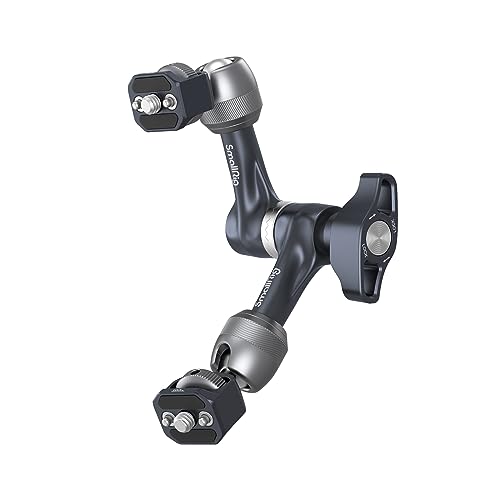
SMALLRIG
SmallRig 7-inch Rosette Magic Arm
An ARRI rosette arm, which is the standard for a handgrip because a rosette cannot rotate under load the way a friction ball can.
- Mount
- ARRI rosette
Needs a rosette on the cage.
Check price
SMALLRIG
SmallRig Universal Basic Shoulder Mount Kit
A shoulder pad, rods and handles, which is the cheapest way to move a camera's weight off your wrists and onto your body.
- Rods
- 15 mm
Basic, and genuinely enough to start.
Check priceWhen to move to a shoulder rig or a gimbal
| Situation | Best answer | Why |
|---|---|---|
| Light rig, static or slow shots | Handle and technique | Nothing else adds less weight |
| Rig over about 5 lb | Shoulder rig | Arm fatigue limits takes before anything else |
| Walking with a subject | Gimbal | Rotational shake is what makes walking unwatchable |
| Long focal length, must be steady | Tripod or monopod | No handheld technique survives at 85mm and up |
| All-day gimbal operating | Gimbal plus vest | Fatigue, not stabilisation, is the limit |
| Fast reactive documentary | Handheld, wide, braced | Anything else is too slow to deploy |
The bottom row matters more than the rest. On reactive work, deployment speed beats stabilisation quality, because a stabilised shot you did not get is worth nothing. That is why the run and gun starter build has no gimbal on it and no shoulder rig either.
Rig changes that improve handheld footage
Lower the monitor. A monitor high on an arm is mass on a lever at the top of the rig, and it amplifies every input from your hands. A SmallRig Monitor Mount with NATO Clamp beside the handle rather than above it makes a measurable difference to how the rig behaves.
Add rearward mass rather than removing mass. A very light rig has little rotational inertia and reacts to every twitch. A SmallRig VB99 Mini V-Mount, 99Wh at the rear both powers the rig and gives it enough inertia to smooth out small inputs, which is why professional cameras are not light by accident.
Widen your grip. Two hands far apart on a rig control rotation better than two hands close together, in the same way a longer wrench applies more torque. A SmallRig 7-inch Rosette Magic Arm that positions a second grip at a comfortable angle is worth more than its price suggests.
What to accept rather than fix
Handheld footage is supposed to look handheld. A small amount of movement communicates presence and immediacy, and that is why documentary and observational work uses it deliberately rather than as a compromise. Chasing perfect stillness with handheld technique produces a shot that is neither locked off nor alive.
The failure to avoid is not movement, it is unmotivated movement: drift, small corrections, and the slow settling that happens when someone is trying to hold still and failing. That reads as a mistake, while a deliberate reframe reads as a choice.
The practical version: if you cannot hold it still, move it on purpose. A slow deliberate push or a controlled reframe looks better than a static shot that is quietly wandering, and it is available at no cost with no equipment.
Next, from here
- Best shoulder rigs
When the rig gets heavy enough.
- Gimbal versus shoulder rig
Two answers, by shot type.
- Rig balance and centre of gravity
Why lowering the monitor helps.
- Shutter angle and frame rate
Why 1/50 is not negotiable.
- Best gimbals
When movement is genuinely the job.
- Run and gun starter build
A rig built for speed rather than stabilisation.
Common questions
- How do I shoot steady handheld footage without a gimbal?
- Brace both elbows against your ribs, hold the rig at chest height rather than eye height, keep your knees soft, and shoot wide. Angular shake is magnified by focal length, so the same wobble that is invisible at 24mm is obvious at 85mm. Add a slow heel-to-toe walk with short steps and a controlled exhale through the shot, and most handheld problems disappear.
- Does a faster shutter speed reduce camera shake?
- No, it makes shake look worse. A 180 degree shutter at 1/48 or 1/50 blurs motion naturally, so small shake blends into that blur. At 1/250 every frame is crisp, so shake becomes a sequence of sharp displaced images, which reads as jitter. Keep the shutter at 180 degrees and use ND filters to control exposure instead.
- Is in-body stabilisation enough for handheld video?
- At wide focal lengths and slow movement, often yes. It stops being enough at longer focal lengths and on fast direction changes, where two artefacts appear: warping in the corners as the correction varies across the frame, and a drift after a fast move as the system recentres. Electronic stabilisation shows both more than sensor-shift does.
- Why does my walking footage bounce even with a gimbal?
- Because a three axis gimbal corrects pan, tilt and roll, which are rotations, and the up-and-down movement of your stride is a translation. Nothing in the gimbal addresses it. The fixes are physical: bend your knees, roll heel to toe, take shorter steps, or transfer the rig to a support vest that decouples it from your stride.
- Should I make my rig as light as possible for handheld?
- No. A very light rig has little rotational inertia, so every small hand movement produces visible motion. A moderately heavy, well-balanced rig resists small inputs and produces smoother handheld footage, which is why professional cameras are not light by accident. Lightness is a virtue on a gimbal, where mass is a payload cost, and a mixed blessing in the hand.
- At what weight do I need a shoulder rig?
- Around 5 lb of loaded rig. Below that, a top handle and two hands held close to the body is steadier, faster to deploy and packs smaller. Above it, arm fatigue starts limiting take length before anything else does, and moving the load onto your shoulder with the battery counterbalancing at the rear is the fix.
Totalling your own rig weight against your gimbal payload? The Camera Rig Build Planner is the paid version of these pages: 8 printable worksheets you fill in with your own numbers, plus the full PDF, $29.