Best Camera Sliders for Video in 2026
Short answer
The best camera slider for most people is the Ikan SLD-31 carbon fibre slider at around $164, because a 31 inch manual slider covers every move a single-camera shoot actually needs and carbon keeps it light enough to carry. If you shoot timelapse or need repeatable moves, the iFootage Shark Nano II at $699 motorises the same idea properly.
A slider is the cheapest genuinely cinematic move available, and the most commonly abandoned purchase in a camera kit. The pick is the Ikan SLD-31 Carbon Fibre Slider, 31 inch at around $164, because carbon fibre at 31 inches is light enough to actually carry and long enough for any move a single camera shoot needs. If you need repeatable or timelapse moves, the iFootage Shark Nano II 660 Motorised Slider at $699 is the motorised answer, and the GVM 32-inch Motorised Carbon Slider at $249 is the affordable middle.
Why sliders get abandoned
Not because the move is bad. Because of setup time. A slider needs a flat surface or two stands, levelling, a head, balance and, on a longer slider, support in the middle. That is five to ten minutes for a three second shot, and on a day with a schedule the slider stays in the bag.
Everything about choosing one should be aimed at that. A slider you set up in ninety seconds gets used ten times as often as one that takes ten minutes, and a shot you actually get beats a smoother shot you did not. That is why the recommendation here is short and light rather than long and rigid.
The second reason is that the move often has no purpose. A slow drift across a static subject reads as filler, and audiences notice movement without motivation. A slider earns its place when the move reveals something: a foreground element passing, a change in the relationship between two subjects, a reveal from behind an obstruction.
Where most buyers should look
$164 to $290. One manual and light, two motorised at a price where motorisation is worth trying.

Ikan
Ikan SLD-31 Carbon Fibre Slider, 31 inch
A manual carbon slider, and manual is the honest starting point: most slider shots are short, slow and better done by hand.
- Length
- 31 in
No motor, no app, no batteries.
Check price
GVM Great Video Maker
GVM 32-inch Motorised Carbon Slider
Motorised with app control and timelapse modes, which is what a slider needs to be useful for interview b-roll you shoot alone.
- Length
- 32 in
- Control
- App
The value motorised pick.
Check price
NEEWER
NEEWER 31.5-inch Motorised Slider
The same class of tool with a carbon rail and app control, worth comparing on price on the day you buy.
- Length
- 31.5 in
Check payload against your rig weight.
Check priceLength, and the argument for short
| Length | Travel you get | What it costs you |
|---|---|---|
| Under 24 in | A subtle drift, enough for a parallax reveal | Almost nothing. It fits in a bag |
| 31 to 32 in | A real move that reads on screen | Needs two stands or a wide flat surface |
| 40 in and up | A dramatic traverse | Mid-span sag, two heavy stands, its own case |
| Motorised, any length | Repeatable moves and timelapse | Power, a controller, and setup time again |
Most people overbuy length and then discover that the middle of a long slider sags under a loaded rig, which introduces a slight rise and fall through the move that is very visible on a locked-off frame. A shorter slider with a stiff rail produces a cleaner move than a longer flexible one, and it is the one that ends up in the bag.
Manual or motorised
A manual slider with good damping and a human hand produces an excellent move, and it produces it immediately. There is no controller to configure, no battery to charge and no menu to navigate. For single-take narrative and documentary work this is genuinely the better tool.
Motorisation earns its price in three specific cases: timelapse, where a move over an hour is not something a hand can do; repeatability, where take four has to match take one exactly; and solo operation, where you need to be in front of the camera rather than behind it. The iFootage Shark Nano II 660 Motorised Slider and the GVM 32-inch Motorised Carbon Slider both cover those.
The edelkrone SliderPLUS solves a different problem: it travels twice its own length, because the rail moves as well as the carriage. On location where there is nowhere to put a 40 inch rail, that is the whole product.
When the move has to repeat, or the space is not there
$699 to $900. Motorised control and a travel-doubling design, for the two problems a plain rail cannot solve.

IFOOTAGE
iFootage Shark Nano II 660 Motorised Slider
A 26-inch motorised unit small enough to live in a camera bag, which is the difference between owning a slider and using one.
- Length
- 26 in
Short travel by design.
Check price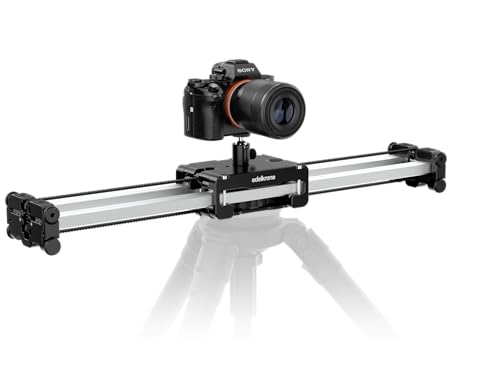
edelkrone
edelkrone SliderPLUS
Travels twice its own length, which is the only real answer to a slider being too long to carry and too short to be interesting.
- Feature
- 2x travel
For operators who fly with a slider.
Check priceWhat a slider needs around it
A head. A slider carriage has a 3/8-16 thread and nothing else, so the fluid head is a separate purchase, and it is the part that decides whether a slider move can also be a pan. A Benro S4 PRO Flat Base Fluid Head at $160 is enough for a light rig and a Benro S6 PRO Fluid Video Head at $265 covers a caged body with a monitor.
Support. A slider on a table is fine. A slider on two stands needs sturdy ones, and a K&F Concept 10.8ft Heavy Duty C-Stand at around $98 is the honest minimum, because a light stand flexes and the flex shows up as a wobble at the start and end of every move.
Sandbags. A Sandbag Weight Bags, Four Pack set is fifteen dollars and it stops the whole assembly from tipping when the carriage reaches the far end and the centre of mass moves outside the leg triangle. This is the failure that destroys cameras, and it is entirely preventable.
What to buy with it
The head, the support and the ballast. A slider without these three is a rail you cannot safely use.

Benro
Benro S4 PRO Flat Base Fluid Head
8.8 lb capacity with two counterbalance steps on a flat base, which fits the stills tripod you already own.
- Capacity
- 8.8 lb
- Base
- Flat
For a bare body and a small lens.
Check price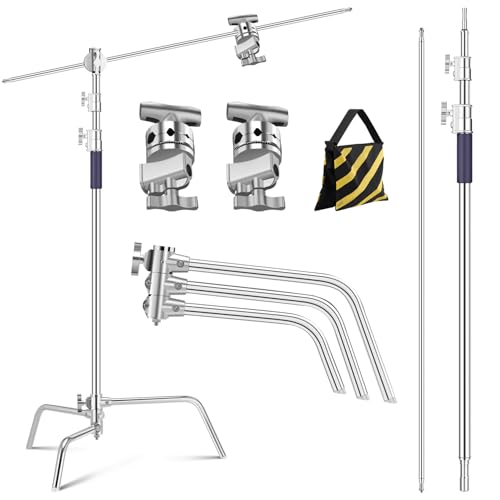
K&F CONCEPT
K&F Concept 10.8ft Heavy Duty C-Stand
Stainless steel with a grip head and arm, which is the stand that holds a modifier out over a subject instead of directly under it.
- Height
- 10.8 ft
- Includes
- Grip arm
Add a sandbag. Always.
Check price
Aimosen
Sandbag Weight Bags, Four Pack
The cheapest insurance on set. A C-stand with a light on an arm falls over, and it falls onto a person.
- Quantity
- 4
Getting a clean move
Level the rail first, with a bubble level or the level on your fluid head. A rail that is even slightly off level means gravity is pulling the carriage, which shows up as an acceleration through the move that no amount of damping hides. This is the single most common cause of a slider shot that feels wrong without an obvious reason.
Push from the base of the carriage, not from the camera. Pushing the camera applies a torque that rocks the whole rig on its head. A hand flat on the carriage plate transmits a linear force, which is what you want.
Start rolling before you move and keep rolling after you stop. Trimming a move at both ends in the edit gives you a clean, decisive in and out, and it means an unsteady start does not cost you the take. Long, slow moves also need shorter focal lengths than people expect, because a slider move at 85mm looks like a jitter and the same move at 24mm looks like a drift.
How we chose
These picks come from published length, load rating and material specifications, motor and controller documentation where relevant, and verified owner reviews describing setup time and rigidity in use. We did not have all of these sliders in our hands and will not pretend otherwise.
The criteria in order: how quickly it sets up, how stiff the rail is under a real load, whether it can be carried without its own case, and only then how long the travel is. Motorisation was judged on whether it solves a problem a hand cannot, rather than on feature count.
Next, from here
- Best fluid heads
The other half of every slider purchase.
- Best C-stands
What a slider actually needs to sit on.
- Gimbal versus shoulder rig
The other two ways to move a camera.
- Narrative working build
Where a slider sits in a full narrative kit.
- Best video tripods
The support the slider borrows its head from.
- Three point lighting
What makes a slider move actually reveal something.
Common questions
- How long should a camera slider be?
- Around 31 inches suits most single-camera work. Shorter than 24 inches gives a subtle drift that still reads on screen and fits in a bag. Longer than 40 inches introduces mid-span sag under a loaded rig, which puts a slight rise and fall into the move, and needs two heavy stands plus its own case. A shorter stiff rail produces a cleaner move than a longer flexible one.
- Is a motorised slider worth the money?
- Only for three jobs: timelapse, where the move happens over an hour and no hand can do it; repeatable takes, where take four must match take one; and solo work where you need to be in front of the camera. For single-take documentary and narrative work, a well-damped manual slider and a human hand produce an excellent move with no setup, no battery and no controller.
- Do I need a fluid head on a slider?
- Yes, unless you only ever want a pure linear move. The carriage gives you a 3/8-16 thread and nothing else, so tilt, level and any pan during the move all come from the head. A head with counterbalance also holds the camera steady when the carriage stops rather than letting it nod, which is what makes the end of a move look deliberate.
- Why does my slider move look uneven?
- Most often because the rail is not level, so gravity is accelerating the carriage through the move and no amount of damping hides that. Level the rail with a bubble level before anything else. The second cause is pushing the camera instead of the carriage, which applies a torque that rocks the rig on its head. Push flat on the carriage plate instead.
- Can I put a slider on two light stands?
- Yes, with sturdy stands and sandbags on the legs. A slider on stands is a cantilever, and when the carriage reaches the far end the centre of mass can move outside the leg triangle and tip the whole assembly. C-stands are the honest minimum because light stands flex, and that flex appears as a wobble at the start and end of every move.
- What focal length works best for slider moves?
- Wider than you think. A slider move at 85mm reads as a jitter because small errors in the rail translate into large angular changes at the frame edge, while the same move at 24mm reads as a smooth drift and shows the parallax that makes the shot worth doing. If you want a slider move to be visible, put something in the foreground rather than reaching for a longer lens.
Totalling your own rig weight against your gimbal payload? The Camera Rig Build Planner is the paid version of these pages: 8 printable worksheets you fill in with your own numbers, plus the full PDF, $29.