Best Video Tripods for Camera Rigs in 2026
Short answer
The best video tripod for most rigs is the Benro A2573FS6PRO with the S6 PRO head at around $315, because the head has six counterbalance steps and a 13.2 lb capacity, which is what a caged mirrorless body with a monitor actually needs. If the budget is under $150, buy the K&F Concept 80 inch kit at $100 and plan to replace the head, not the legs.
A video tripod is two purchases pretending to be one, and only one of them matters. The Benro Video Tripod with S6 PRO Fluid Head at around $315 is the pick because the head is a real counterbalanced fluid head rather than a stiff ball, and the head is what makes a pan look intentional. On a tight budget the K&F Concept 80-inch Video Tripod with Fluid Head at $100 is honest about what it is, and the right plan there is to replace the head later and keep the legs. If weight is the constraint, the SmallRig 63-inch Carbon Fibre Video Tripod AP255Pro at $170 puts carbon legs under a usable head.
The head is the tripod
People shop for legs and then live with the head, which is backwards. The legs hold the camera at a height and stop it falling over, and almost any set of legs does that. The head decides whether a pan accelerates smoothly, whether a tilt stays where you leave it, and whether the frame settles or bounces when you stop the move. Every complaint about a video tripod is really a complaint about its head.
The two specifications that matter are capacity and counterbalance. Capacity is the mass the head is designed to carry, and exceeding it means the tilt will not hold. Counterbalance is a spring or cam system that pushes back against the camera as it tilts, so a tilted camera stays tilted instead of flopping forward. A head with no counterbalance has to be locked, and a locked head cannot be tilted during a shot.
Counterbalance is quoted in steps: two, six, eight and so on. More steps means a finer match to your actual rig weight, and a head matched to your rig feels weightless while an unmatched one fights you in one direction and runs away in the other. That is the whole reason a six step head at $265 feels different from a two step head at $160.
Entry and travel picks
$100 to $170. Complete kits with a head included, chosen for what they honestly are rather than for their spec sheets.
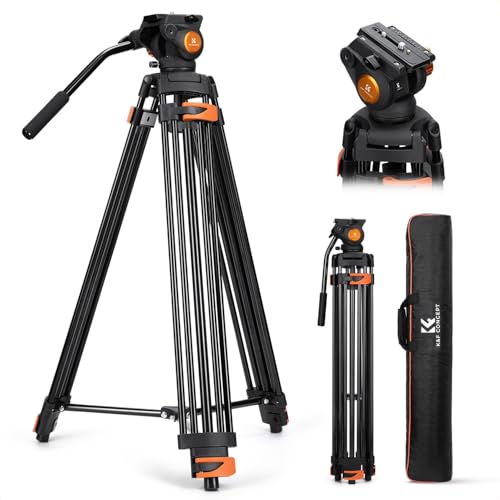
K&F CONCEPT
K&F Concept 80-inch Video Tripod with Fluid Head
A tall aluminium video tripod with a basic fluid head, which is enough to hold a mirrorless body still and to learn what you actually need next.
- Height
- 80 in
- Head
- Included, fluid
The head is the part you will outgrow first.
Check price
NEEWER
NEEWER 74-inch Video Tripod with Fluid Head
Heavy-duty aluminium legs with a quick release plate and a 360 degree fluid drag head, sold as a set so nothing needs matching.
- Height
- 74 in
Fine for static interviews.
Check price
SMALLRIG
SmallRig 63-inch Carbon Fibre Video Tripod AP255Pro
Carbon legs with a fluid head at a weight that fits a carry-on, which is the trade a travelling documentary shooter actually wants.
- Material
- Carbon fibre
- Height
- 63 in
Lighter legs mean more care in wind.
Check priceBowl or flat base, and why levelling matters
A flat base head bolts to the legs with a 3/8-16 screw, and levelling it means adjusting the individual legs until the head sits level, which on uneven ground takes real time. A bowl base head sits in a hemisphere and levels with a single knob in about five seconds, which is why every professional video tripod uses one.
The bowl size is a compatibility standard: 65mm, 75mm and 100mm are the common sizes, and a head with a 75mm ball fits a 75mm bowl and nothing else. The Manfrotto 504X Fluid Head with 645 Fast Twin Tripod uses a 75mm bowl, which is the sensible standard for anything up to a small cinema camera.
A levelling centre column, as on the Benro Video Tripod with S6 PRO Fluid Head, is the compromise between the two. It is not as fast as a bowl and it is far faster than adjusting legs, and it means a flat base head can still be levelled quickly. On a documentary day where you set up thirty times, the difference between five seconds and ninety seconds of levelling is most of an hour.
Reading the specification honestly
| Specification | What it actually tells you | What to watch for |
|---|---|---|
| Head capacity | The mass the tilt mechanism can hold and counterbalance | Measure your loaded rig, not the bare body |
| Counterbalance steps | How finely the head can be matched to your rig | Two steps is a compromise, six or more is a match |
| Max height | Usually measured with the centre column fully raised | Height with the column down is the usable figure |
| Leg material | Aluminium is heavier and cheaper, carbon is lighter and damps better | Carbon matters if you carry it, not if you drive it |
| Number of leg sections | More sections pack smaller and are less rigid | Three sections is the sweet spot for video |
| Base type | Flat, or a bowl with a size in millimetres | A bowl levels in five seconds. It is worth the price |
| Spreader | Ground level or mid level, ties the legs together | Mid level spreaders survive uneven ground better |
The height figure is the one that misleads most often. A tripod quoted at 80 inches usually reaches that only with the centre column fully extended, and a raised centre column is the least stable configuration a tripod has. Judge a tripod by its height with the column down, which is often eight to twelve inches lower than the headline number.
Buy-once picks
$315 to $999. A real counterbalanced head on legs that do not flex, which is what a loaded rig actually needs.

Benro
Benro Video Tripod with S6 PRO Fluid Head
A real counterbalanced head rated to 13.2 lb on legs with a levelling column, which is where pans stop looking like a stills tripod pretending.
- Capacity
- 13.2 lb
- Counterbalance
- 6 step
The buy-once pick for mirrorless and small cine bodies.
Check price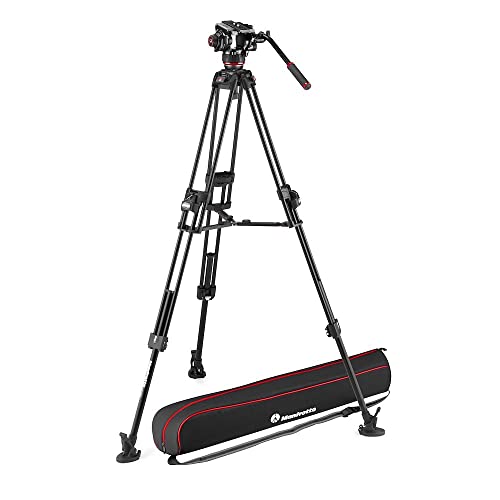
Manfrotto
Manfrotto 504X Fluid Head with 645 Fast Twin Tripod
A 75mm bowl system with continuous counterbalance on twin-leg aluminium, which is the standard rental-house answer for a loaded cine build.
- Bowl
- 75 mm
- Legs
- Twin, aluminium
Heavy. Do not buy this to carry it far.
Check priceMatching the tripod to the rig you actually own
Start with a real number. A caged mirrorless body, a fast standard zoom, a monitor, a microphone and a battery plate is typically 3.5 to 5 lb, which is comfortably inside an 8.8 lb head. Add a matte box, a follow focus and a V-mount and you are at 8 to 11 lb, which needs a 13.2 lb head. A cinema body with a zoom and wireless focus reaches 15 to 20 lb and needs the 17.6 lb class or above.
The rig weight calculator adds this up properly. It is worth doing before buying a head rather than after, because a head that is undersized cannot be fixed with technique, and a head that is oversized feels stiff and vague under a light camera.
The rule that saves money: buy the head for the rig you will have in a year, and buy the legs for the rig you have now. Heads are the expensive, long-lived part and they get replaced when your camera changes. Legs last decades and hardly ever need upgrading, which is exactly why the budget entry strategy of good legs and a replaceable head works so well.
What people get wrong
- Buying on maximum height rather than on height with the centre column down, which is the height you will actually use.
- Ignoring the head capacity because the camera is light, then adding a monitor, a matte box and a battery and going straight past it.
- Buying carbon legs for a tripod that lives in a car, where the weight saving buys nothing and costs several hundred dollars.
- Using a stills ball head for video, which cannot pan and tilt smoothly because it is one locking joint rather than two damped ones.
- Leaving the legs partly retracted for a lower height instead of spreading them wider, which is far less stable.
- Never using the hook or a sandbag, which is what stops a loaded rig going over in wind or when somebody catches a leg.
That last one is worth fifteen dollars of prevention. A set of Sandbag Weight Bags, Four Pack on the spreader or the hook is the cheapest insurance a rig has, and the failure it prevents is the one that ends with a lens on concrete.
How we chose
These picks come from published capacity and counterbalance specifications, stated materials, bowl and base standards, and verified owner reviews describing behaviour under load over time. We did not have every one of these tripods in our hands and will not claim otherwise.
The criteria in order: head capacity against realistic loaded rig weights, counterbalance quality and step count, how quickly it levels, rigidity with the legs fully extended, and only then weight and packed size. Price mattered least, because the difference between a frustrating tripod and a good one shows up on every single shot.
Next, from here
- Best fluid heads
The part that actually decides how a pan looks.
- Tripod and fluid head guide
Levelling, drag, counterbalance and technique.
- Rig weight calculator
The number a head capacity has to cover.
- Best camera sliders
The other thing your fluid head will sit on.
- Narrative starter build
Where sticks matter more than stabilisation.
- Best C-stands
What holds everything that is not the camera.
Common questions
- Do I need a video tripod or can I use my photo tripod?
- The legs are usually fine; the head is not. A stills ball head is a single locking joint, so it either holds still or moves freely, with nothing in between. Video needs two independently damped axes with counterbalance, so a pan accelerates smoothly and a tilt stays where you leave it. Buying a flat base fluid head for your existing legs is often the cheapest useful upgrade in a whole kit.
- What head capacity do I need?
- Weigh the loaded rig, not the body. A caged mirrorless camera with a fast zoom, monitor and microphone is typically 3.5 to 5 lb and fits an 8.8 lb head. Add a matte box, follow focus and V-mount and you are at 8 to 11 lb, which needs the 13.2 lb class. A cinema body with a zoom and wireless focus reaches 15 to 20 lb and needs 17.6 lb or above.
- What does counterbalance actually do?
- It applies a spring or cam force that pushes back against the camera as it tilts, so a tilted rig stays where you put it instead of flopping forward or springing back. Without it you have to lock the head, and a locked head cannot tilt during a shot. More counterbalance steps means a finer match to your specific rig weight, which is what makes a good head feel weightless in the hand.
- Is a bowl base worth it over a flat base?
- On any shoot with more than a handful of setups, yes. A bowl levels the head with one knob in about five seconds, while a flat base means adjusting individual legs until the head sits level, which takes a minute or more on uneven ground. Across a documentary day with thirty setups that is most of an hour. A levelling centre column is a reasonable middle ground.
- Are carbon fibre legs worth the extra money?
- Only if you carry the tripod. Carbon saves roughly a third of the weight and damps vibration slightly better, which matters on a hike or a travel shoot and buys nothing when the tripod lives in a car. If the choice is carbon legs with a poor head or aluminium legs with a good head, take the good head every time.
- Why does my tripod wobble when I pan?
- Most often because the centre column is raised, which turns a stable triangle into a mast. Lower the column and spread the legs wider instead. The other common causes are partly retracted lower leg sections, which are the thinnest and least rigid, and a head that is under-loaded or over-loaded relative to its counterbalance range, so the rig fights the mechanism rather than working with it.
Totalling your own rig weight against your gimbal payload? The Camera Rig Build Planner is the paid version of these pages: 8 printable worksheets you fill in with your own numbers, plus the full PDF, $29.