Best C-Stands for Film and Video in 2026
Short answer
The best C-stand for most people is the NEEWER Pro stainless C-stand with a boom arm at around $180, because stainless steel resists the corrosion and thread wear that kills cheaper stands, and the grip head is the part that fails first. If you need three or four stands rather than one, the K&F Concept 10.8 ft stand at $98 is the honest volume buy.
A C-stand is the most used and least discussed item in a lighting kit. The NEEWER Pro Stainless C-Stand with Boom Arm at around $180 is the pick because stainless resists the corrosion that seizes threads on cheaper stands, and because the grip head and arm are where every C-stand eventually fails. If you are buying three or four at once, the K&F Concept 10.8ft Heavy Duty C-Stand at $98 is the honest volume answer, and the NEEWER Basics Stainless C-Stand with Boom Arm at $130 sits between them.
What a C-stand does that a light stand does not
Three things. It holds weight far off-axis, because the grip head and arm let you position a load a metre to one side of the vertical column, which is how a flag gets between a light and the lens without a stand in shot. It has a turtle base with legs at different heights, so the stand can be positioned tight against a wall or with a leg tucked under a table. And it is built from steel rather than aluminium tube, so it does not flex under a heavy head.
A light stand does none of those. It holds a light directly above its own base and it flexes. That is fine for a small panel and useless for a flag, a scrim or a boom arm carrying a COB light.
The three-height leg design is the part that people miss. Those legs are staggered deliberately so two stands can be nested together and so the tallest leg can always be placed underneath the arm, which is the single most important safety rule on a set.
The stands
$98 to $180. All three hold a light. The differences are corrosion resistance, grip head quality and how much play develops in the arm over time.
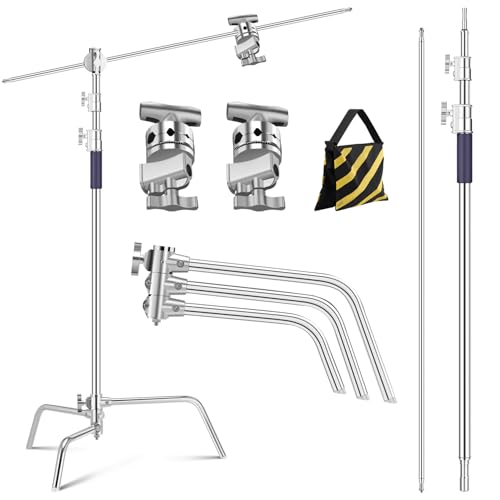
K&F CONCEPT
K&F Concept 10.8ft Heavy Duty C-Stand
Stainless steel with a grip head and arm, which is the stand that holds a modifier out over a subject instead of directly under it.
- Height
- 10.8 ft
- Includes
- Grip arm
Add a sandbag. Always.
Check price
NEEWER
NEEWER Basics Stainless C-Stand with Boom Arm
A 10.5 ft stainless C-stand with a boom arm at a price that lets you buy two, and two is the number a lighting setup actually needs.
- Height
- 10.5 ft
- Material
- Stainless
Heavy to carry, which is the point.
Check price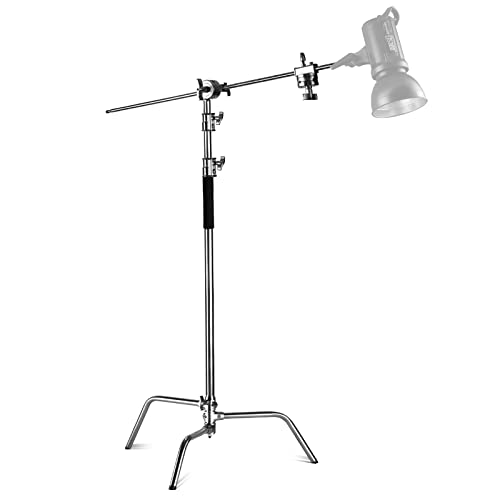
NEEWER
NEEWER Pro Stainless C-Stand with Boom Arm
The heavier version with a turtle base, which is what you want under a 4x4 frame in any kind of breeze.
- Base
- Turtle
For frames and heavy fixtures.
Check priceThe safety rules, which are not optional
- The tallest leg goes under the arm. This puts the base directly beneath the load and is the difference between a stable stand and a lever waiting to tip.
- Sandbag the leg on the same side as the arm, not a random leg. A Sandbag Weight Bags, Four Pack set of four is around $16 and is the cheapest insurance a set has.
- Tighten the grip head knobs so the arm rotates clockwise into the tightening direction under load. If gravity is loosening the knob, you have mounted it backwards.
- Raise the top riser first and the bottom riser last. The bottom sections are the thickest and most rigid, so they should carry the extension.
- Never extend a stand to full height with a heavy head on it outdoors. Wind loads on a flag or a softbox are much larger than people expect.
- Route cables down the column and secure them, so nobody pulls a stand over by tripping on a cable.
The knob direction rule is the one that separates people who have worked on a set from people who have not. The arm should be positioned so that the weight of the load tries to rotate the arm in the same direction that tightens the knob. Mounted the other way, the load slowly unscrews its own mount over the course of an hour, and then it falls.
What to hang on it
A COB light, most obviously. A amaran 200x S Bi-Colour COB or a Godox SL-60W Daylight COB on a boom arm, through a softbox, is the standard key light setup and it needs a stand that can hold that mass out to one side.
A frame. The Westcott Scrim Jim Cine 4x4 Kit is a 4 by 4 foot frame that takes diffusion or a solid, and it is the single tool that most changes how light looks. It also has a large surface area, which is why the sandbag rule matters more with a frame than with a light.
A monitor, a boom pole, a background, a reflector, a slider end, or a camera on a magic arm for a locked-off second angle. This is why the answer to how many C-stands you need is always one more than you own.
The grip package around them
The frame, the ballast and the boxes. These three plus a couple of stands is a complete grip kit for a small narrative shoot.

Westcott
Westcott Scrim Jim Cine 4x4 Kit
A modular 4x4 frame with diffusion and a silver or white bounce, which is the tool that makes a hard light behave like a window.
- Size
- 4 x 4 ft
- Fabrics
- Diffusion, bounce
Needs two stands and sandbags.
Check price
Aimosen
Sandbag Weight Bags, Four Pack
The cheapest insurance on set. A C-stand with a light on an arm falls over, and it falls onto a person.
- Quantity
- 4

Inracity
Apple Box Full Set of Five
Apple boxes raise a subject, level a tripod leg and hold a light down, and no other tool on set is this reusable.
- Set
- 5 sizes
How many, and what size
| Shoot | Stands | Why |
|---|---|---|
| Single interview, one light | 2 | One key, one for a flag or a bounce |
| Interview with background separation | 3 | Key, back light, and a flag or negative fill |
| Small narrative scene | 4 to 6 | Key, fill, back, a frame, and one spare that gets used |
| Anything with a 4x4 frame | Add 1 | A frame usually wants a second stand to stop it pivoting |
| Product or tabletop | 2 to 3 | Overhead boom, side flag, and a bounce |
On height, a 10 to 11 foot stand covers almost everything indoors, including a boom over a table and a key light above eye level. Taller stands exist and are mostly for exterior work with large sources. Buying two 10 foot stands beats buying one 14 foot stand for nearly every small production.
Steel, aluminium and what actually wears out
C-stands are usually chrome-plated steel or stainless steel, and both are heavy on purpose. The weight is the point: it lowers the centre of mass and adds stability. An aluminium stand marketed as a lightweight C-stand is usually a light stand with a grip head bolted to it, and it will flex under a boomed load.
What fails first is never the column. It is the grip head, specifically the knobs and the thread they run in, because those get overtightened, cross-threaded and dropped. A stand with a well-machined grip head lasts decades and a stand with a soft one develops slop within a year, which shows up as a light that slowly droops during a take.
Stainless matters most if the stands live in a van, get rained on or go anywhere near a beach. Chrome plating chips, the steel underneath rusts, and a rusted riser becomes a riser that no longer slides. If your stands stay indoors, plated steel is fine and cheaper.
How we chose
These picks come from published materials and dimensions, stated load figures, grip head design, and verified owner reviews describing wear over years of use. We did not have every one of these stands in our hands and will not pretend otherwise.
The criteria in order: grip head quality, corrosion resistance, riser rigidity under a boomed load, and turtle base geometry. Maximum height came last, because two shorter stands beat one taller one on almost every small production.
Next, from here
- Best light modifiers
The frames and boxes a C-stand exists to hold.
- Best COB lights
The mass that decides how much stand you need.
- Three point lighting
What the stands are actually arranging.
- Narrative working build
Where grip becomes a real part of the budget.
- Best camera sliders
A slider on stands needs C-stands, not light stands.
- Best LED panel lights
The lighter loads that a smaller stand can carry.
Common questions
- What makes a C-stand different from a light stand?
- A grip head and arm that let you position a load a metre off-axis from the column, a turtle base with legs at three different heights so it can tuck against walls and under furniture, and steel construction that does not flex under a boomed load. A light stand holds a light directly above its own base and flexes, which is fine for a small panel and useless for a flag or a frame.
- Which leg goes under the load on a C-stand?
- The tallest one, always. The legs are staggered at three heights specifically so the tallest can be placed directly beneath the arm, putting the base under the load instead of turning the stand into a lever. Then sandbag the leg on the same side as the arm. Those two habits prevent almost every C-stand accident that happens on small sets.
- Which way should the grip head knobs tighten?
- Mount the arm so the weight of the load rotates it in the same direction that tightens the knob. If gravity is working against the thread, the load slowly unscrews its own mount over the course of an hour and then falls. This is the rule that separates people who have worked on a set from people who have not, and it takes two seconds to check.
- How many C-stands do I need?
- Two for a single interview with one light, three once you add background separation, and four to six for a small narrative scene. Any shoot using a 4 by 4 frame usually wants an extra stand to stop the frame pivoting. The practical answer is that the number is always one more than you own, which is why buying two mid-priced stands beats one expensive one.
- Are stainless C-stands worth the extra money?
- If they travel, get rained on or go near salt air, yes. Chrome plating chips, the steel underneath rusts, and a rusted riser stops sliding. If your stands live indoors in a studio, plated steel is fine and costs less. In both cases spend the difference on grip head quality instead, because that is the part that actually wears out.
- How tall should a C-stand be?
- Ten to eleven feet covers almost everything indoors, including a boom arm over a table and a key light well above eye level. Taller stands are mostly for exterior work with large sources, and they are less stable at full extension. Two ten foot stands are more useful on a small production than one fourteen foot stand, because you almost always need a second position more than extra height.
Totalling your own rig weight against your gimbal payload? The Camera Rig Build Planner is the paid version of these pages: 8 printable worksheets you fill in with your own numbers, plus the full PDF, $29.