Best COB LED Lights for Video in 2026
Short answer
The best COB light for most small productions is the amaran 200x S at around $279, because roughly 200 W of bi-colour output through a Bowens mount covers a key light through a softbox at practical distances. If the budget is tight, the Godox SL-60W at $109 is a genuinely usable daylight key for an interview in a controlled room.
A COB light is a single powerful emitter in a housing with a standard accessory mount, and it is the workhorse of any narrative kit. The amaran 200x S Bi-Colour COB at around $279 is the pick because 200 W through a Bowens mount and a softbox is enough key light at a workable distance. Below that the Godox SL-60W Daylight COB at $109 is honest, and above it the Aputure Amaran 300c RGB COB at $455 adds full RGB control.
Why the inverse square law decides your purchase
Light falls off with the square of distance. Double the distance from a source to a subject and you get a quarter of the light. That single relationship explains why headline wattage figures are so misleading and why people so often buy a light that turns out to be too small.
A 60 W COB at one metre with a bare reflector is very bright. The same light at three metres through a softbox is a fraction of that, because you have tripled the distance and added a modifier that costs one to two stops. Softboxes are not free: the diffusion that makes light flattering also throws a large amount of it away.
The practical consequence: buy more output than you think you need, because you will use modifiers and you will need distance. A light at half power that is comfortably bright is far more useful than a light running at full output that is only just adequate, because the first one has headroom and runs cooler and quieter.
Where most buyers should look
$109 to $279. A daylight-only budget key, a 100 W bi-colour, and the 200 W that covers a key through a softbox at real distances.
GODOX
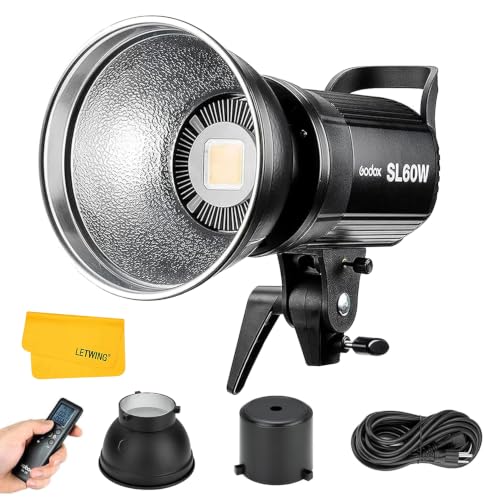
Godox SL-60W Daylight COB
A Bowens-mount daylight COB for the price of a softbox, which is the cheapest entry into point-source lighting that takes real modifiers.
- Output
- 60 W
- Mount
- Bowens
Mains power only, and the fan is audible.
Check price
Amaran
Amaran Halo 100x Bi-Colour COB
100 W bi-colour in a monolight body, small enough to travel and bright enough to bounce off a ceiling in a normal room.
- Output
- 100 W
- Colour
- Bi-colour
A good first light for interviews.
Check price
Aputure
amaran 200x S Bi-Colour COB
200 W bi-colour with app control, which is the sweet spot where one light can key a subject through a diffusion frame in daylight-balanced conditions.
- Output
- 200 W
- Mount
- Bowens
The value pick for a first real key.
Check priceDaylight, bi-colour or RGB
A daylight-only fixture produces a fixed colour temperature around 5600 K and puts all of its LED capacity into that one output, which means it is the brightest option per dollar. If you always gel or always shoot daylight-balanced, this is efficient.
A bi-colour fixture mixes warm and cool emitters, so it tunes from roughly 2700 K to 6500 K. The cost is that at any given setting some emitters are running below full, so peak output is lower than a daylight fixture of the same nominal wattage. The benefit is matching practical lights and window light without gels, which on location saves real time.
RGB fixtures like the Aputure Amaran 300c RGB COB add full colour control, which is genuinely useful for background and effect lighting and largely irrelevant for a key on a face. Buy RGB for the second and third lights in a kit, not for the first one.
Reading the specification honestly
| Specification | What it means | What to look for |
|---|---|---|
| Wattage | Power drawn, loosely correlated with output | Compare lux at distance, not watts |
| Lux at 1 m | Measured output with the standard reflector | The comparable figure. Note the modifier used |
| CRI and TLCI | Colour accuracy against a reference | CRI 95 or above, TLCI 95 or above |
| Colour temperature range | The tuning span on a bi-colour | 2700 K to 6500 K covers practical work |
| Mount | The accessory standard on the front | Bowens. Anything else limits your modifiers |
| Power input | Mains, V-mount, or both | V-mount capable matters on location |
| Fan noise | Audible cooling during dialogue | Look for a quiet mode, and test it |
Fan noise is the specification nobody checks and everybody regrets. A light two metres from a subject with an audible fan is on your dialogue track permanently. Most fixtures have a quiet or silent mode that reduces output, and knowing whether yours is usable at that setting matters more than the difference between two similarly specified lights.
The Bowens mount is the real product
Bowens is an accessory mount standard originating in stills strobes, and it has become the default for continuous LED fixtures. A Bowens mount means every softbox, lantern, dome, snoot, fresnel and reflector made for that standard fits your light, from any brand.
A fixture with a proprietary mount locks you into one manufacturer's modifier catalogue at their prices, and it makes borrowing or renting a modifier impossible. This is a much bigger practical constraint than a small difference in output, and it is the reason every light recommended here is Bowens.
The modifiers matter more than the fixtures do. A SmallRig 35-inch Bowens Softbox at $68 or a amaran Lantern 65 Softbox at $69 change the quality of the light completely, and they will outlast several generations of LED fixture because they contain no electronics.
Bigger fixtures
$319 to $1,059. More output for larger modifiers and longer throws, plus full RGB control on the middle option.
GODOX
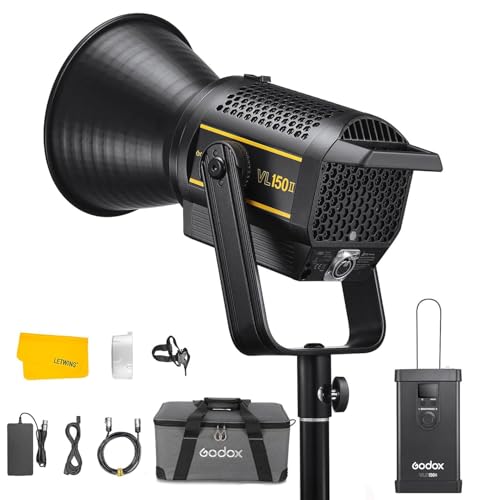
Godox VL150 II Daylight COB
165 W daylight balanced with a quiet mode, aimed at people who need output and cannot have a loud fan in the room.
- Output
- 165 W
- CCT
- 5600 K
Daylight only, no colour tuning.
Check price
Aputure
Aputure Amaran 300c RGB COB
300 W of full colour on a Bowens mount, which is enough to push through a 4x4 diffusion frame and still expose at a working stop.
- Output
- 300 W
- Colour
- RGBWW
Needs a real stand and a sandbag.
Check price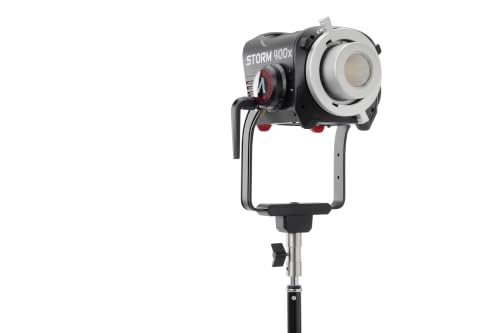
Aputure
Aputure Storm 400x V-Mount Monolight
400 W class output that will run from V-mount batteries, which is what makes a big light usable on location without a generator.
- Output
- 400 W class
- Power
- V-mount capable
Battery runtime is short at full output.
Check pricePower, and the mains versus battery decision
A 200 W fixture at full output draws roughly 200 W plus conversion losses. Running that from a 99 Wh V-mount gives you under thirty minutes. This is the single most common surprise in the category, and it means location lighting is a mains job unless you plan properly.
Planning properly means either large batteries, like the SmallRig VB212 V-Mount, 212Wh at 212 Wh, or accepting a lower output setting, or running from mains. A 200 W fixture at 25 percent output draws around 50 W and will run for four hours on a 212 Wh cell, which is a workable plan if the light is close to the subject.
The Aputure Storm 400x V-Mount Monolight takes V-mount directly, which is why it exists in that form. For a documentary crew who cannot rely on a socket, a fixture that mounts its own battery is worth a real premium over one that needs an adapter, a cable and a plate.
How many lights, and in what order
- One key. A single soft source, positioned off-axis and slightly above eye level, does eighty percent of the work in a portrait or interview.
- Negative fill before positive fill. A black flag on the shadow side shapes a face more than a second light does, and it costs almost nothing.
- A back or hair light, small and easily controlled, to separate the subject from the background.
- A background light, which is the first genuinely useful place for an RGB fixture.
- Practicals in frame, which sell the scene as a real place more than any amount of correct exposure does.
- A second key, only when you are lighting two subjects who cannot share one.
The negative fill step is where inexperienced lighting kits go wrong. People buy a second light to fill the shadow side and end up with a flat face lit from both directions. A Westcott Scrim Jim Cine 4x4 Kit with a solid, or even a black cloth on a stand, produces a better result and is a fraction of the price.
How we chose
These picks come from published output and lux figures, stated CRI and TLCI values, mount standards, power input specifications, and verified owner reviews describing fan noise and colour consistency. We did not have every one of these fixtures in our hands and will not claim otherwise.
The criteria in order: usable output at realistic distances through a modifier, colour accuracy, mount standard, power flexibility, and fan noise. Wattage on its own was not treated as an output figure, because it is not one.
Next, from here
- Best light modifiers
What actually changes the quality of the light.
- Three point lighting guide
Key, fill, back, and why negative fill comes first.
- Best C-stands
What safely holds a boomed COB light.
- Best LED panel lights
The softer, more portable alternative.
- Narrative working build
Where a two-light kit belongs.
- Best V-mount batteries
The runtime reality of battery lighting.
Common questions
- How much light output do I actually need?
- More than the headline wattage suggests, because light falls off with the square of distance and a softbox costs one to two stops. A 60 W fixture is bright at one metre with a bare reflector and marginal at three metres through a softbox. Around 200 W covers a key through a softbox at practical distances, and a light running at half power is more useful than one running flat out.
- Should I buy daylight, bi-colour or RGB?
- Daylight-only is the brightest per dollar because all the LED capacity goes into one output. Bi-colour tunes from about 2700 K to 6500 K and saves real time matching practicals and windows on location, at some cost in peak output. RGB is genuinely useful for background and effect lighting and largely irrelevant for a key on a face, so buy it for the second or third fixture.
- Why does the Bowens mount matter?
- Because it is the standard that every softbox, lantern, dome, snoot and reflector attaches to, from any brand. A proprietary mount locks you into one manufacturer at their prices and makes borrowing or renting a modifier impossible. Modifiers change the quality of light far more than the fixture does, and they outlast several generations of LED, so mount compatibility matters more than a small output difference.
- Can I run a COB light from a V-mount battery?
- For a limited time. A 200 W fixture at full output drains a 99 Wh cell in under thirty minutes, which surprises almost everyone. Running the same fixture at 25 percent draws around 50 W and gives roughly four hours on a 212 Wh cell, which is workable if the light is close to the subject. Location lighting is a mains job unless you plan for it deliberately.
- What CRI should I look for in a video light?
- CRI 95 or above, and TLCI 95 or above, since TLCI is measured for camera response rather than for the human eye. Below that, skin tones shift in ways that are difficult to correct because the deficiency is in specific wavelengths rather than a uniform cast. Colour accuracy matters more than raw output on any light that will hit a face.
- Is fan noise a real problem?
- Yes, and almost nobody checks it before buying. A light two metres from a subject with an audible fan is on your dialogue track permanently, and it cannot be removed cleanly afterwards. Most fixtures offer a quiet mode that reduces output, so what matters is whether the light is still bright enough at that setting. Test it before a shoot, not during one.
Totalling your own rig weight against your gimbal payload? The Camera Rig Build Planner is the paid version of these pages: 8 printable worksheets you fill in with your own numbers, plus the full PDF, $29.