Best SSDs for Video Editing and Offload in 2026
Short answer
The best portable SSD for video work is the Samsung T9 1TB at around $237, because it sustains write speeds high enough to record to directly and fast enough to offload a shoot day in minutes. Buy two rather than one large one, because two drives means a failure costs half a day instead of all of it.
Every shoot generates files that have to leave the card the same night, and a portable SSD is where they go. The Samsung T9 1TB Portable SSD at around $237 is the pick because it sustains a genuine write rate rather than a burst one, which matters both for offload and for cameras that record directly to a drive. Buy two. The Samsung T9 2TB Portable SSD at $406 makes sense once a single project outgrows a terabyte, and the OWC Envoy Ultra 2TB Thunderbolt 5 is for editing rather than for carrying.
Two different jobs, one product category
The first job is offload: getting footage off cards at the end of a day, twice, onto two separate drives. This needs capacity and sustained write speed, and it does not need extreme performance, because you are copying while you eat.
The second job is recording directly. Blackmagic bodies record BRAW to an external drive over USB-C, and external recorders write ProRes to SSDs. This is a real-time operation with no second chance, so the drive must sustain its write rate continuously with no dips. A drive that dips for a second during an offload costs you nothing; the same dip during a take drops frames.
The third, sometimes, is editing directly from the drive. That mostly needs read speed and a fast interface, and it is where a Thunderbolt drive like the OWC Envoy Ultra 2TB Thunderbolt 5 pulls ahead of a USB one in a way that is genuinely noticeable on a timeline.
The working drives
$210 to $406. One terabyte is the working size; two terabytes is for projects that outgrow it.
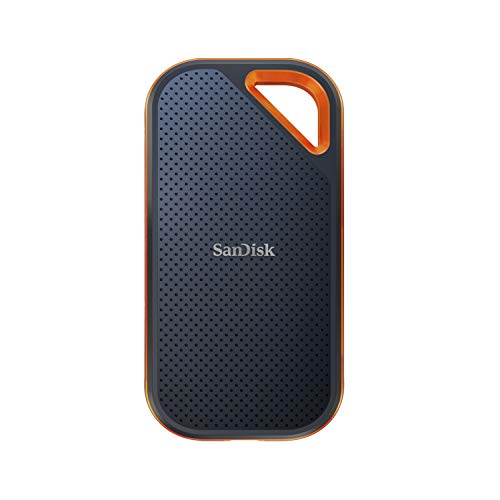
Sandisk
SanDisk Extreme PRO 1TB Portable SSD
Up to 2000 MB/s over USB 3.2 Gen 2x2 with an IP65 rating, which is the practical floor for a drive that gets thrown in a bag.
- Capacity
- 1 TB
- Speed
- Up to 2000 MB/s
The first offload drive to buy.
Check price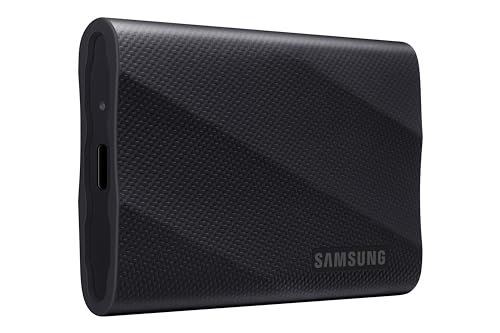
Samsung
Samsung T9 1TB Portable SSD
The same 2000 MB/s class in a smaller shell that holds speed better under a long sustained copy.
- Capacity
- 1 TB
The value pick for daily offloads.
Check price Samsung
Samsung T9 2TB Portable SSD
2 TB covers a RAW shoot day twice over, which is what a two-copy backup rule actually requires.
- Capacity
- 2 TB
Buy two and keep them apart.
Check priceSustained write, cache and the trap in cheap drives
Most consumer SSDs use a fast cache region and a slower main region. Writes go into the cache at the headline speed until it fills, then drop to the speed of the underlying flash, which on cheap drives can be a quarter of the advertised figure or worse. On a small file copy you never see this. On a 200 GB offload or a continuous recording, you see it very clearly.
This is the single reason to buy a known drive rather than the cheapest one with the same capacity on the label. The advertised number is real; it is just measured over a window that does not resemble a video workload.
The practical test, if you already own a drive and want to know: copy 100 GB in one operation and watch the transfer rate. A drive that starts at 900 MB/s and settles at 800 is fine. One that starts at 1,000 and collapses to 150 will not work for direct recording and will make your offloads take four times as long as you expected.
Interfaces, and what each one is worth
| Interface | Realistic throughput | What it is good for |
|---|---|---|
| USB 3.2 Gen 1 | About 450 MB/s | Offload only. Slow for a big day |
| USB 3.2 Gen 2 | About 1,000 MB/s | Offload and most direct recording |
| USB 3.2 Gen 2x2 | About 2,000 MB/s | Fast offload, limited host support |
| Thunderbolt 3 or 4 | About 2,800 MB/s | Editing from the drive directly |
| Thunderbolt 5 | About 6,000 MB/s | Multi-stream editing, large project drives |
Match the drive to the host. A Thunderbolt 5 drive on a USB-C laptop port runs at USB speeds, and the money spent on the interface is doing nothing. Check what your machine and your camera actually offer before paying for headroom that neither end can use.
Recording directly to a drive
Blackmagic Pocket bodies and most external recorders can record straight to a USB-C SSD, which is the cheapest large-capacity recording media available. BRAW at 400 Mbps is 180 GB per hour, and a $237 terabyte drive holds five and a half hours of it. That is a fraction of what the same capacity of CFexpress costs, and it is one of the strongest practical arguments for a Blackmagic body.
Two things to watch. First, mount the drive properly rather than letting it hang on its cable: a SmallRig 9.8-inch Magic Arm or a cage-mounted holder stops the connector taking the strain, and a disconnected drive mid-take loses the take. Second, check your camera's approved media list, because some drives are known to dip and are excluded for good reason.
Format the drive in the camera, not on a computer, and keep it dedicated to recording. Using a recording drive as a general working drive is how fragmentation and background processes end up interrupting a take.
Around the drive
A Thunderbolt drive for editing, a fast reader so the cards clear quickly, and a case so none of it arrives damaged.

OWC
OWC Envoy Ultra 2TB Thunderbolt 5
Thunderbolt speeds fast enough to edit RAW directly off the drive, which removes an entire copy step from the day.
- Interface
- Thunderbolt 5
Only worth it with a Thunderbolt machine.
Check price
ProGrade Digital
ProGrade CFexpress Type B Reader (USB4)
A fast reader is not optional with CFexpress: a slow one turns a 512 GB card into a lunch break.
- Interface
- USB4
Buy this with your first CFexpress card.
Check price
Pelican
Pelican Vault v525 Case with Padded Dividers
A rig that gets carried in a soft bag arrives with its rods bent, and a bent rod is a matte box that will not seat.
- Type
- Hard case
The backup discipline that actually works
- Offload every card to two separate drives before any card is reused. Two copies on one drive is one copy.
- Verify the copy, using checksums if your offload software supports them, rather than trusting that the file count matched.
- Keep the original cards full until the project is delivered. They are your third copy and they cost nothing to leave alone.
- Label drives by project and date, physically, with tape and a marker. Identical black drives are how footage gets overwritten.
- Move anything you want to keep for years off SSD and onto spinning disk or cloud storage, because flash loses charge over long periods without power.
- Never format a card in the field to make room. Buy another card, because that moment is when a day exists in exactly one place.
That last rule is the one that saves projects. Every story about lost footage contains a moment where somebody formatted a card to keep shooting. A Delkin 512GB CFexpress Type B 4.0 costs less than reshooting anything.
How we chose
These picks come from published sustained and peak throughput figures, interface specifications, stated endurance, camera manufacturer approved media lists, and verified owner reviews describing behaviour on large sustained transfers. We did not have every one of these drives in our hands and will not claim otherwise.
The criteria in order: sustained write speed on a large transfer, interface matched to realistic hosts, whether the drive appears on camera approved lists, physical robustness, and capacity per dollar. Peak read speed mattered least except for editing directly from the drive.
Next, from here
- Media workflow and backup
The offload routine, step by step.
- Storage per hour calculator
How much drive a shoot day needs.
- Best CFexpress cards
Where the footage comes from.
- Best monitor recorders
The devices that write straight to a drive.
- ProRes versus BRAW
Two workflows with very different storage costs.
- Storage per hour chart
Every common codec in one table.
Common questions
- What SSD do I need to record video directly?
- One that sustains its write rate continuously rather than dipping when its cache fills, on a USB 3.2 Gen 2 or faster interface. Check the camera manufacturer's approved media list first, since drives are excluded from those lists for measured reasons. Mount the drive so its connector is not taking strain, because a disconnection mid-take loses the take rather than degrading it.
- How big an SSD do I need for video?
- One terabyte is the working size for most people, and buying two beats buying one two terabyte drive because a failure or a loss then costs half a day rather than all of it. At BRAW 400 Mbps a terabyte holds around five and a half hours, and at ProRes 422 HQ it holds around two and a half. Match the capacity to a shoot day, not to a project.
- Why does my drive slow down during a big transfer?
- Because the fast cache region filled and writes fell back to the slower underlying flash. Most consumer drives do this, and on cheap ones the drop can be to a quarter of the advertised speed or worse. It never shows up on small file copies, which is what most reviews measure. Copy 100 GB in one operation and watch the sustained rate to see the real number.
- Is Thunderbolt worth it over USB for video drives?
- For editing directly from the drive, yes, because the higher throughput is visible on a multi-stream timeline. For offload and for camera recording, USB 3.2 Gen 2 at around 1,000 MB/s is already faster than the workload. Also check your host: a Thunderbolt 5 drive on a plain USB-C port runs at USB speeds, and the interface premium buys nothing.
- Can I use an SSD as my archive?
- Not on its own. Flash memory holds data by trapped charge, which leaks slowly over years when the drive is unpowered, so an SSD left in a drawer for five years is not a reliable archive. Use SSDs as working and offload drives, then move anything you intend to keep long term onto spinning disks or cloud storage, ideally in more than one place.
- How many copies of my footage should I keep?
- Two separate drives before any card is reused, with the original cards left full until delivery as a third copy that costs nothing. Verify the copies with checksums rather than trusting matching file counts. The single rule that prevents most footage loss is never formatting a card in the field to make room, because that is the moment a shoot day exists in exactly one place.
Totalling your own rig weight against your gimbal payload? The Camera Rig Build Planner is the paid version of these pages: 8 printable worksheets you fill in with your own numbers, plus the full PDF, $29.