Video Storage Per Hour Chart: Cards, Drives and a Full Shoot Day
Short answer
A 240 Mbps all-intra codec consumes 108 GB per hour, so a 512 GB card holds about 4.7 hours and a 1 TB drive holds about 9. Plan drive space at double your recorded hours, because two copies on separate physical drives are required before any card is reused.
Storage planning fails in one specific way: people budget for the recording and forget that everything is stored twice. A shoot generating 400 GB consumes 800 GB of drive space, and that is before the archive. The tables below give storage per hour by codec, capacity by duration, and a worked plan for a real shoot day using a Samsung T9 1TB Portable SSD pair.
Storage per hour by codec
| Codec | Bitrate | Per hour | Per 8 hour day at 3 hours recorded |
|---|---|---|---|
| H.264 1080p long-GOP | 50 Mbps | 22 GB | 66 GB |
| H.264 4K long-GOP | 100 Mbps | 45 GB | 135 GB |
| H.265 4K 10-bit long-GOP | 150 Mbps | 68 GB | 204 GB |
| All-intra 4K 10-bit | 240 Mbps | 108 GB | 324 GB |
| All-intra 4K 60p | 400 Mbps | 180 GB | 540 GB |
| ProRes 422 4K | 590 Mbps | 266 GB | 798 GB |
| ProRes 422 HQ 4K | 880 Mbps | 396 GB | 1,188 GB |
| BRAW 6K at 5:1 | 400 Mbps | 180 GB | 540 GB |
| ProRes RAW HQ 4K | 1,700 Mbps | 765 GB | 2,295 GB |
| 8K RAW | 2,600 Mbps | 1,170 GB | 3,510 GB |
Every figure in the right-hand column doubles once the backup discipline is applied, because two copies on separate drives are required before any card is reused. A ProRes 422 HQ day at three recorded hours is 1.2 TB of footage and 2.4 TB of drive space.
How long each capacity lasts
| Capacity | At 150 Mbps | At 240 Mbps | At 400 Mbps | At 880 Mbps |
|---|---|---|---|---|
| 128 GB | 1.9 h | 1.2 h | 0.7 h | 0.3 h |
| 256 GB | 3.8 h | 2.4 h | 1.4 h | 0.6 h |
| 512 GB | 7.5 h | 4.7 h | 2.8 h | 1.3 h |
| 1 TB | 14.7 h | 9.3 h | 5.6 h | 2.5 h |
| 2 TB | 29.4 h | 18.5 h | 11.1 h | 5.1 h |
| 4 TB | 58.8 h | 37.0 h | 22.2 h | 10.1 h |
This table is the argument for 512 GB cards and 1 TB drives as the practical working sizes. A 512 GB card is between one and seven hours depending on codec, which is a shoot day at the rates most people use, and losing one costs part of a day rather than the whole thing.
Planning a real day
- Estimate recorded hours, not hours on location. A documentary day with eight hours on location typically produces two to four hours of material.
- Multiply by the per hour figure for your codec to get the footage size.
- Double it for the two-drive backup requirement. This is the number that actually determines what drives you carry.
- Divide the footage size by your card capacity to get the number of cards, then add one spare so you never format in the field.
- Add capacity for separate audio files if you record dual system, which is small but goes on the same drives.
- Check offload time, since a slow reader on a large card can consume most of an evening.
A worked example. Four recorded hours at 240 Mbps is 432 GB of footage, 864 GB of drive space across two drives, and one 512 GB card plus one spare. Two Samsung T9 1TB Portable SSD drives and two Delkin 512GB CFexpress Type B 4.0 cards covers that comfortably with room for a longer day.
The offload side
$105 to $406. Two working drive sizes and the reader that makes clearing cards take minutes instead of an evening.
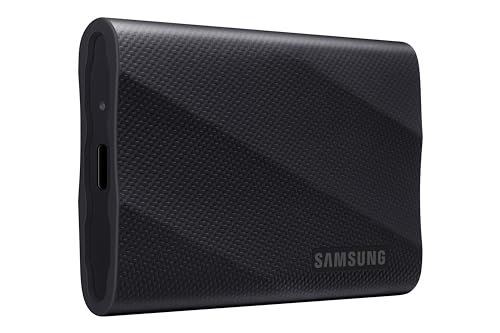
Samsung
Samsung T9 1TB Portable SSD
The same 2000 MB/s class in a smaller shell that holds speed better under a long sustained copy.
- Capacity
- 1 TB
The value pick for daily offloads.
Check price Samsung
Samsung T9 2TB Portable SSD
2 TB covers a RAW shoot day twice over, which is what a two-copy backup rule actually requires.
- Capacity
- 2 TB
Buy two and keep them apart.
Check price
ProGrade Digital
ProGrade CFexpress Type B Reader (USB4)
A fast reader is not optional with CFexpress: a slow one turns a 512 GB card into a lunch break.
- Interface
- USB4
Buy this with your first CFexpress card.
Check priceOffload time, which nobody budgets for
A fast reader on USB4 clears a 512 GB CFexpress card in a few minutes. A cheap USB 3.0 reader can take half an hour for the same card, and that is per card, per copy. On a shoot with four cards a day and two copies of each, the difference between those two readers is several hours a week.
Drive write speed matters equally. A portable SSD that sustains 800 MB/s writes 512 GB in about eleven minutes; one that drops to 150 MB/s after its cache fills takes nearly an hour. That collapse never shows up in a review that copies small files.
Plan for offload as part of the day rather than as an afterthought. On a multi-day shoot, an offload that takes three hours every night is a real constraint on how much sleep the person doing it gets, and tired people make backup mistakes.
Working storage and archive storage
SSDs are working drives. Flash memory holds data as trapped charge that leaks slowly when unpowered, so an SSD in a drawer for five years is not an archive. Use them for production and offload, where speed is the point.
For anything worth keeping, use spinning disks or cloud storage or both. Spinning disks are cheap per terabyte and can sit powered down for years, though spinning them up periodically is sensible. Cloud storage removes physical risk entirely at an ongoing cost.
The practical routine for a small operation is two SSDs during production, then a copy onto a large spinning disk and a copy into cloud storage at delivery, then the SSDs get reused for the next project. That gives three copies at rest on two different technologies.
Where storage costs get out of hand
- RAW at high resolutions. Eight K RAW at 1,170 GB per hour means a single shoot day can exceed 3 TB before backups.
- Multi-camera events, where three cameras running continuously for six hours produce eighteen recorded hours.
- High frame rate work, since bitrate scales roughly with frame rate and a 120 fps take consumes five times a 24 fps one.
- Keeping everything forever, which accumulates faster than any sensible archive budget.
- External recorders, because ProRes is several times the storage of a camera codec on every project.
- Failing to cull. Deleting obvious failures at offload is legitimate and most people never do it.
The last two are the ones worth acting on. An external recorder is a permanent multiplier on storage cost, which is a real reason to think twice about one when a camera has a good internal codec. And discarding source media after delivery is a genuine option that people are unreasonably reluctant to take.
Next, from here
- Storage per hour calculator
Your own codec and your own day.
- Codec bitrate chart
The same data organised by codec.
- Best SSDs for video
The drives this planning assumes.
- Media workflow and backup
The routine that saves projects.
- Best CFexpress cards
Sizing cards to a shoot day.
- Codecs explained
Why the bitrates differ so much.
Common questions
- How much storage does an hour of 4K video use?
- It depends entirely on the codec. Four K long-GOP at 100 Mbps is 45 GB per hour, 10-bit all-intra at 240 Mbps is 108 GB, ProRes 422 HQ at 880 Mbps is 396 GB, and ProRes RAW HQ at 1,700 Mbps is 765 GB. Multiply the bitrate in megabits per second by 450 to get gigabytes per hour for any codec.
- How many hours fit on a 512 GB card?
- About 7.5 hours at 150 Mbps, 4.7 hours at 240 Mbps, 2.8 hours at 400 Mbps and 1.3 hours at 880 Mbps. That range is why 512 GB is the practical working size: it covers a shoot day at the codecs most people use, and losing one card costs part of a day rather than everything.
- How much drive space do I need for a shoot day?
- Double your footage size, because two copies on separate physical drives are required before any card is reused. Four recorded hours at 240 Mbps is 432 GB of footage and 864 GB of drive space. Two copies on the same drive is one copy, since a single drive failure takes both.
- How long does it take to offload a card?
- A few minutes for a 512 GB CFexpress card on a USB4 reader, and up to half an hour on a cheap USB 3.0 reader, per card and per copy. Drive write speed matters equally: a portable SSD sustaining 800 MB/s writes 512 GB in about eleven minutes, while one that collapses to 150 MB/s takes nearly an hour.
- Can I archive footage on an SSD?
- Not reliably. Flash memory stores data as trapped charge that leaks slowly when the drive is unpowered, so an SSD left in a drawer for five years is a working drive being used as an archive. Use spinning disks, which are cheap per terabyte and hold data powered down for years, or cloud storage, ideally both.
- What size drives should I buy for video?
- One terabyte as the working size, and buy two rather than one two terabyte drive, because a failure or a loss then costs half a day rather than all of it. A terabyte holds about nine hours at 240 Mbps and two and a half hours at ProRes 422 HQ, which covers a single-camera day at most codecs.
Totalling your own rig weight against your gimbal payload? The Camera Rig Build Planner is the paid version of these pages: 8 printable worksheets you fill in with your own numbers, plus the full PDF, $29.