Narrative Set Workflow: How a Scripted Camera Build Is Operated
Short answer
A narrative set works from a shot list and repeats takes, so the camera build is optimised for control and consistency rather than speed. Focus is marked and rehearsed, exposure is set with fixed ND in a matte box between setups, and every choice is made so that take four cuts with take one.
A narrative set inverts almost every documentary assumption. You decide what happens next, takes repeat, and the failure mode is not missing a moment but ending up with a shot that does not cut with the one before it. That is why the rig is built around a Tilta Pocket Follow Focus and a Tilta Mirage Matte Box rather than around autofocus and a variable ND.
The requirement is consistency, not speed
On a scripted shoot the same moment is filmed several times, from several angles, sometimes hours apart. Those pieces have to cut together, which means exposure, colour, focus behaviour and framing all have to be repeatable rather than merely good.
This is why manual control wins here and loses on a documentary shoot. Autofocus is faster and more accurate moment to moment, and it makes a slightly different decision on every take. A marked focus pull is identical every time by construction, which is what the edit actually needs.
The same logic explains fixed ND in a tray rather than a variable on the lens. A variable ND is set by feel and cannot be returned to exactly, and a two thirds of a stop difference between a wide and a close-up is a colour and exposure mismatch that shows in the cut.
The order of a setup
- Block the scene with the actors, walking it at performance pace, and find the positions that matter.
- Mark actor positions on the floor with tape, and mark the camera position if it moves.
- Set the lighting for the master, because the wide shot constrains where lights can be.
- Set exposure with a fixed ND in the tray, and note the density so it can be repeated.
- Measure focus distances from the sensor plane and mark the follow focus disc.
- Rehearse the full move, focus and all, at performance speed three times.
- Roll, and slate, and let the take run past the last line before cutting.
The blocking step first is what separates a set that runs from one that stalls. Lighting a scene before knowing where people stand means relighting, and relighting with a crew waiting is the most expensive way to spend an hour on a small production.
Filtration between setups, not during
A matte box with trays is the right tool here because a filter change is a deliberate act between setups rather than an adjustment during a take. The Tilta Mirage Matte Box takes both square trays and round filters, and a K&F Concept 4x5.65 Filter Tray spare means the ND and the diffusion each live permanently mounted.
Note the filtration for each setup as part of the camera notes. If the wide was shot with a 1/8 diffusion and the close-up was not, they will not cut, and the difference is very hard to identify afterwards because diffusion is subtle by design.
Fixed ND rather than variable is the same principle. A Hoya PRO ND-EX 77mm Kit (ND8, ND64, ND1000) gives you three known densities, and known is the operative word: a setup shot at ND64 can be matched exactly tomorrow, and a setup shot at "about two thirds round on the variable" cannot.
Focus as a repeatable operation
Mark the disc, set the A and B stops at the extremes of the actual move, and rehearse three times. That routine is the same whether the follow focus cost $59 or $899, and it is the routine rather than the hardware that makes the pull land.
Measure from the sensor plane, which is marked on most camera bodies, rather than from the front of the lens. On a long lens that difference is easily fifteen centimetres, which at a wide aperture on a close subject is the entire depth of field and is why some setups are mysteriously soft.
Run the depth of field numbers before a difficult scene. If the answer is a few centimetres and the actor is moving, the honest choices are to stop down, add light so you can, or accept that some takes will miss. Discovering that during the take costs you the setup.
The control package
$59 to $219. A manual follow focus, a matte box that takes trays, and a set of fixed NDs whose densities can be recorded and repeated.

Tilta
Tilta Pocket Follow Focus
A geared manual wheel with A and B stops and fluid damping on a 15mm rod clamp, which is the whole job for a fraction of a wireless system.
- Type
- Manual, geared
- Mount
- 15mm rod
Manual only, and that is often the right answer.
Check price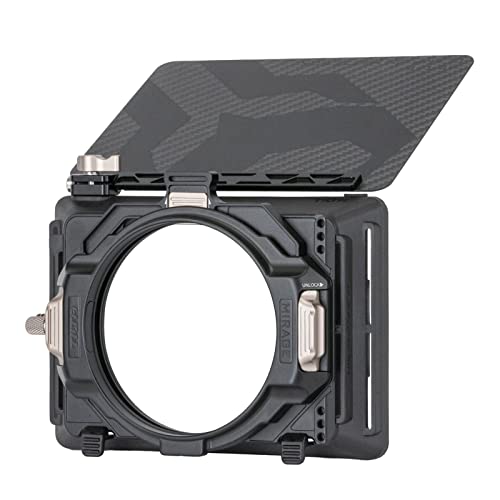
Tilta
Tilta Mirage Matte Box
Takes both 4x5.65 trays and 95mm circular filters with adapter rings down to 67mm, so one box covers a whole mixed set of lenses.
- Filters
- 4x5.65 and 95mm round
- Rings
- 67 to 82 mm
The pick for a small narrative kit.
Check price
Hoya
Hoya PRO ND-EX 77mm Kit (ND8, ND64, ND1000)
Three fixed densities rather than a variable, which is what you use when colour accuracy matters more than changing exposure without stopping.
- Densities
- 3, 6 and 10 stops
Slower to work with, cleaner results.
Check priceCamera notes, which nobody wants to keep
| Record | Why it matters | When it bites |
|---|---|---|
| Lens and focal length | Matching coverage across angles | The close-up does not match the wide |
| T-stop | Exposure and depth of field consistency | Two shots in a scene look different |
| ND density | Repeating a setup on another day | A pickup shot cannot be matched |
| Diffusion strength | Subtle and invisible until it mismatches | Half a scene has a different texture |
| White balance | Colour consistency across the scene | The grade has to fight each shot separately |
| Focus marks | Repeating a pull after a break | Rehearsal has to start over |
On a small production nobody wants to be the person keeping notes, and the day it matters is always a pickup shot filmed a week later. A photograph of the camera settings screen plus a line in a notes app per setup is enough, and it takes fifteen seconds.
Sound on a scripted set
Boom first, radio as safety. A boomed microphone a foot above the actor and pointing at their mouth is the best sounding option available, and it is possible here because there is a person to hold it and the blocking is known.
Radio microphones still go on the actors as the safety track, because a boom operator loses position sometimes and a rustle on one channel does not have to cost a take. This is the same two source principle as documentary work, arranged in the opposite priority order.
Record room tone in every location and slate every take even if timecode is running. Slating gives you a visual and audible reference that survives a timecode failure, and timecode failures happen quietly rather than obviously.
Why the rig is heavier and that is fine
A narrative build carries rods, a matte box, a follow focus, a monitor and often a wireless transmitter, and it lives on a tripod or a shoulder rig rather than on a stabiliser. Weight stops being a constraint the moment the camera is on sticks, and the rigidity that weight brings is actively useful.
This is the clearest divergence between the two ladders on this site. A documentary rig treats every gram as a cost, because it is being held and stabilised. A narrative rig treats mass as neutral and control as the objective, which is why the two build lists share sound and media and almost nothing else.
The one place the narrative rig still cares about weight is the fluid head. A loaded cine build easily reaches 15 to 20 lb, which needs a 17.6 lb head or above, and a head that is undersized cannot be fixed with technique.
Next, from here
- Narrative starter build
The complete kit, priced and linked.
- Narrative working build
What changes with a small crew.
- Run and gun workflow
The opposite approach, and why it inverts.
- Focus pulling guide
Marks, rehearsal and depth of field.
- Matte box and filtration guide
Trays, stacking and flags.
- Three point lighting guide
Lighting the master first.
Common questions
- Why use manual focus on a narrative set when autofocus is more accurate?
- Because autofocus decides, and it makes a slightly different decision on every take. A scripted scene is filmed several times from several angles and those pieces must cut together, so focus behaviour has to be repeatable rather than merely accurate. A marked pull with hard stops is identical every time by construction, which is what the edit needs.
- Should I use fixed or variable ND on a scripted shoot?
- Fixed, in a matte box tray. A variable ND is set by feel and cannot be returned to exactly, so a two thirds of a stop difference between the wide and the close-up shows up as an exposure and colour mismatch in the cut. A fixed density can be written down and repeated exactly, including on a pickup shot filmed a week later.
- What order should a scripted setup be built in?
- Block the scene with actors first, mark positions on the floor, light for the master because the wide shot constrains everything, set exposure with a known ND density, measure and mark focus, rehearse at performance speed three times, then roll. Lighting before blocking means relighting, and relighting with a crew waiting is expensive.
- What camera notes should I keep on a narrative shoot?
- Lens and focal length, T-stop, ND density, diffusion strength, white balance and focus marks, per setup. A photograph of the settings screen plus a line in a notes app takes fifteen seconds. The day it matters is always a pickup shot filmed a week later, when matching a setup you did not record becomes guesswork.
- Boom or radio microphones on a scripted set?
- Boom as primary, radio as safety. A boomed capsule a foot above the actor pointing at the mouth is the best sounding option available, and it is practical here because there is a person to hold it and the blocking is known. Radio microphones stay on the actors as the safety track, since a boom operator can lose position.
- Why is a narrative rig so much heavier than a documentary one?
- Because weight stops being a constraint once the camera is on a tripod, and the rigidity it brings is useful. A narrative build carries rods, a matte box, a follow focus, a monitor and often a transmitter, all in service of control. A documentary rig treats every gram as a cost because it is being held and stabilised.
Totalling your own rig weight against your gimbal payload? The Camera Rig Build Planner is the paid version of these pages: 8 printable worksheets you fill in with your own numbers, plus the full PDF, $29.