Best Shotgun Microphones for Video in 2026
Short answer
The best shotgun microphone for most video work is the Rode VideoMic NTG at around $239, because it is a genuine short shotgun with a built-in battery, a headphone output and a safety channel, all in a package light enough for a camera-mounted rig. For boomed dialogue on a set, the Sennheiser MKE 600 at $349 is the more capable microphone.
A shotgun microphone is the default first sound purchase and the one most often bought in the wrong length. The Rode VideoMic NTG at around $239 is the pick because it is a proper short shotgun with an internal battery and a safety channel, which means it works on a camera without phantom power and forgives a level mistake. For a boom pole on a set the Sennheiser MKE 600 with Shock Mount at $349 is better, and the Rode NTG5 Kit at $485 is better still and lighter than either.
What a shotgun microphone actually does
It rejects sound from the sides. That is the entire function. A shotgun uses an interference tube in front of the capsule so that off-axis sound arriving at an angle partially cancels itself, which narrows the pickup pattern along the axis you point it. It does not amplify distant sound and it does not zoom.
The practical consequence is that a shotgun makes a subject sound closer by making everything else quieter, not by making the subject louder. Distance still costs you: a microphone at two metres sounds distant no matter how directional it is, because the ratio of direct sound to reflected sound is fixed by geometry. Getting closer is always worth more than getting more directional.
This is why the single most useful sound accessory is a Saramonic BoomPole Lite Carbon Fibre, 8.2 ft at around $99. It puts the microphone a foot above the subject's head instead of on the camera three metres away, and that change does more for dialogue than any microphone upgrade.
Where most buyers should look
$239 to $349. One camera-mount shotgun with an internal battery, and two that expect phantom power and a boom pole.
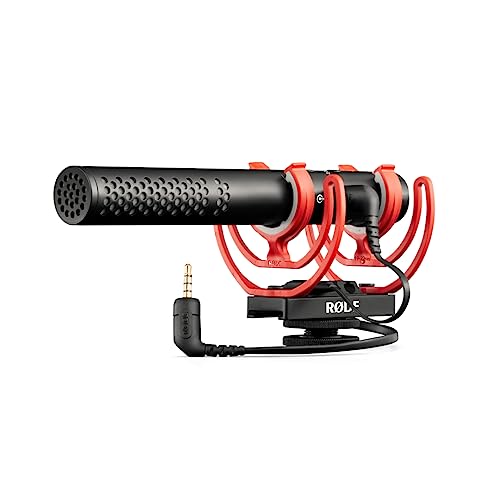
Rode
Rode VideoMic NTG
A shotgun that works on a camera 3.5mm input, over USB, or into a recorder, with a safety channel and a headphone out, which covers every way a solo shooter records sound.
- Power
- USB rechargeable
- Outputs
- 3.5 mm and USB
The single most useful first mic.
Check price
Sennheiser
Sennheiser MKE 600 with Shock Mount
A supercardioid that runs on phantom power or an internal AA, which means it works on a recorder now and on a mixer later.
- Pattern
- Supercardioid
- Power
- 48 V or AA
The value pick for a boom position.
Check price
Deity
Deity S-Mic 3S
A shorter interference tube designed for interiors, where a long shotgun starts colouring reflections off a nearby wall.
- Use
- Interior
Pick this for rooms, not fields.
Check priceWhy long shotguns are wrong indoors
The interference tube only works at wavelengths short enough to interact with it, which means directionality falls apart at low frequencies. A long shotgun is highly directional at speech frequencies and roughly omnidirectional below about 500 Hz, and that mismatch is what produces the boxy, coloured sound people describe when a long shotgun is used in a small room.
Indoors, the reflections arriving off-axis are not rejected as cleanly as the direct sound is captured, and the result is that room tone gets emphasised in exactly the frequency range that sounds worst. A shorter shotgun, or a hypercardioid, is genuinely better in a room even though it is less directional on paper.
The rule that working sound people use: short shotgun or hypercardioid indoors, long shotgun outdoors where there is nothing to reflect. Every microphone in this roundup is short by design, and that is deliberate rather than a budget compromise.
Reading the specification
| Specification | What it means | What to look for |
|---|---|---|
| Self noise | The hiss the microphone makes with no input | Under 15 dBA. Below 12 is excellent |
| Sensitivity | How much signal it produces for a given sound level | Higher is better with a weak preamp |
| Max SPL | The loudest sound it handles without distorting | Over 120 dB covers anything you will record |
| Pattern | Supercardioid, hypercardioid or shotgun | Shorter patterns behave better indoors |
| Power | Phantom 48V, internal battery, or plug-in power | Internal battery means it works on any camera |
| Weight | Mass on a boom pole for hours | Under 150 g matters to whoever is holding it |
Self noise is the specification that separates a good microphone from a cheap one, and it is the one that shows up on quiet dialogue. A microphone with 20 dBA of self noise recording a softly spoken interview produces an audible hiss floor that no amount of noise reduction removes cleanly. The Rode NTG5 Kit is quiet enough that the room is always louder than the microphone, which is the correct relationship.
The boomed setup
$40 to $485. A light, quiet shotgun, a carbon pole to get it close, and the shock mount that stops handling noise reaching the capsule.

Rode
Rode NTG5 Kit
A short shotgun with an unusually clean off-axis response, sold with a shock mount and windshield, which is the kit a boom operator can work with outdoors.
- Pattern
- Supercardioid
- Includes
- Shock mount, windshield
Needs a recorder or a mixer.
Check price
Saramonic
Saramonic BoomPole Lite Carbon Fibre, 8.2 ft
A carbon pole with an internal XLR cable, and internal cabling is what stops a boom operator from being tangled all day.
- Length
- 8.2 ft

SMALLRIG
SmallRig Shotgun Microphone Holder
A shock mount isolates handling noise from the pole, which is why a mic clipped straight to a shoe sounds like a construction site.
- Fits
- 19 to 25 mm
Shock mounts and wind protection are not accessories
A microphone clipped rigidly to a camera or a pole transmits every hand movement, every cable rub and every footstep straight into the capsule as low-frequency thumps. A SmallRig Shotgun Microphone Holder at around $40 suspends the microphone in elastic so those vibrations are absorbed rather than conducted. Without one, a boomed microphone sounds like a construction site.
Outdoors, wind noise is not a nuisance, it is a complete failure. Even a light breeze overloads a microphone capsule with low-frequency energy that no filter recovers. A foam windscreen handles indoor air movement and light breeze; anything more needs a furry cover, and a full blimp for genuinely windy conditions.
Budget for both from the start. A $239 microphone with no shock mount and no wind protection produces worse audio in the field than a $100 microphone with both, and this is one of the most common reasons people conclude their microphone is bad.
Camera mounted or boomed
A camera-mounted shotgun is a compromise that is often correct. It requires nobody else, it points where the camera points, and it is far better than the internal camera microphone. On run and gun work where you are alone and moving, this is the realistic setup, and it is why the Rode VideoMic NTG with its internal battery is the pick.
A boomed microphone is better in every acoustic respect and needs a person. It gets the capsule within a foot of the subject, above the head and pointing down at the mouth, which maximises direct sound and minimises reflections and floor noise. If a second person exists on your shoot, this is where they add the most value.
The narrative answer is boom first, radio microphone as safety. The documentary answer is usually radio first, camera shotgun as safety. Both approaches keep two independent recordings of the same dialogue, which is the actual insurance policy.
How we chose
These picks come from published self noise, sensitivity, pattern and power specifications, stated weights, and verified owner reviews describing indoor and outdoor behaviour. We did not have every one of these microphones in our hands and will not claim otherwise.
The criteria in order: self noise, how the pattern behaves in a real room rather than in an anechoic chamber, how it takes power, weight on a pole, and whether it includes practical features like a safety channel. Maximum SPL mattered least, since dialogue never approaches it.
Next, from here
- Best field recorders
Better preamps than any camera has.
- Best wireless microphones
The other half of a documentary sound kit.
- Audio for video guide
Levels, placement and the two-source rule.
- Narrative starter build
Where boom sound belongs in a full kit.
- Run and gun starter build
The camera-mounted approach in context.
- Timecode generators
Keeping dual-system sound in sync.
Common questions
- Does a shotgun microphone let me record from further away?
- No. A shotgun rejects sound from the sides, which makes everything else quieter rather than making the subject louder. Distance still costs you, because the ratio of direct sound to room reflections is set by geometry and no pattern changes it. A microphone at two metres sounds distant however directional it is, which is why a boom pole is worth more than a microphone upgrade.
- Why does my shotgun microphone sound boxy indoors?
- Because an interference tube only produces directionality at frequencies whose wavelength interacts with it. Below about 500 Hz a long shotgun is close to omnidirectional, so low frequency room reflections are captured while higher frequencies are rejected. That mismatch is the boxy colouration. A short shotgun or a hypercardioid behaves better in a room despite being less directional on paper.
- What self noise figure should I look for?
- Under 15 dBA, and below 12 dBA is excellent. Self noise is the hiss the microphone produces with no input, and it sets the floor beneath quiet dialogue. A microphone at 20 dBA recording a softly spoken interview produces an audible hiss that noise reduction cannot remove cleanly. It is the specification that most reliably separates a good microphone from a cheap one.
- Do I need a shock mount and a windscreen?
- Yes, both, from the start. A rigidly mounted microphone conducts every hand movement and cable rub into the capsule as low frequency thumps. Wind is worse: even a light breeze overloads the capsule with energy no filter recovers. A $239 microphone without them performs worse in the field than a $100 microphone with them, which is why people often blame the microphone.
- Should I mount the microphone on the camera or use a boom?
- Boom if a second person exists, because getting the capsule within a foot of the subject and pointing down at the mouth improves dialogue more than any equipment upgrade. Camera mount if you are alone and moving, which is a realistic compromise and far better than the internal microphone. Either way, keep a second independent recording of the same dialogue as insurance.
- Can I plug a shotgun microphone straight into my camera?
- If it has an internal battery or accepts plug-in power, yes, over a 3.5mm input. Microphones needing 48V phantom power require either an XLR handle, an audio interface or a separate recorder. Camera preamps are also usually noisy, so even when the connection works, a quiet microphone into a good recorder sounds considerably better than the same microphone into a camera.
Totalling your own rig weight against your gimbal payload? The Camera Rig Build Planner is the paid version of these pages: 8 printable worksheets you fill in with your own numbers, plus the full PDF, $29.